Be Your Own Cheat Code: How Curiosity Scales Skill sets
Leave a Comment
By Kelly Neaton, Senior Art Director | S50 Agency
I’ve been animating in After Effects for years. It’s my comfort zone — the place where I know exactly which levers to pull, which expressions to write, which keyframes to nudge. And for a long time, that felt like enough.
But if I’m honest with myself, I knew it wasn’t.
Animation is a broad, endlessly evolving discipline, and I had been living in one corner of it. I kept telling myself I’d explore Procreate’s animation tools eventually — after this campaign wrapped, after Q4 settled down, after things slowed down a little. Anyone in this industry knows that “after things slow down” is a myth. Things don’t slow down. You just choose to grow or you don’t.
The Excuses Were Getting Old
There’s a particular kind of professional restlessness that creeps in when you know you want to expand but you keep finding reasons not to. I wanted to understand illustration-based animation. I wanted to feel the tactile, hand-drawn quality that Procreate offers — something After Effects, for all its power, doesn’t give you. I’d seen @stefankunz’s work floating around and it stopped me every time. The way he moves between illustration and motion felt fluid and intentional and alive.
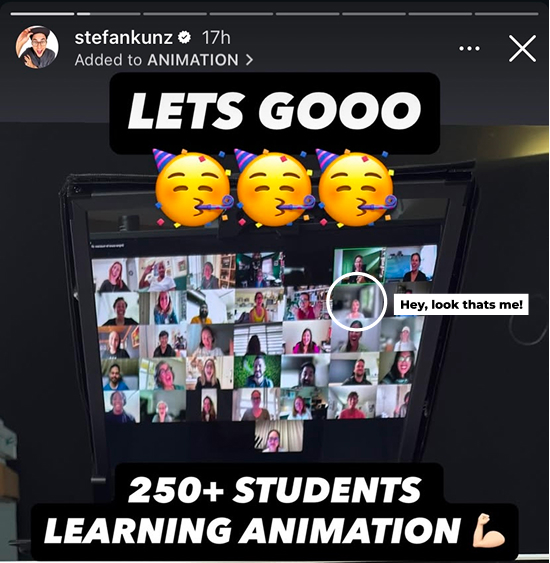
So I signed up for his Procreate Animation Bootcamp and committed to showing up for myself after work hours. No more waiting for the right moment. The right moment was never coming, so I made one.
What the Bootcamp Actually Taught Me
Stefan’s course is the kind of instruction that doesn’t just teach you a tool — it reshapes how you think about movement. Working through Procreate animation from the ground up, I found myself reconnecting with principles I’d applied for years in After Effects but had never approached from an illustrative, frame-by-frame perspective. Timing, easing, squash and stretch — the fundamentals translate, but the feel is completely different. There’s an intimacy to drawing each frame by hand that changes your relationship to motion.
The course gave me a genuinely new medium. And more than that, it gave me confidence in that medium — the kind of confidence you can only get by doing the work, making the bad frames, and figuring out why they’re bad.
Bootcamp Course Week 2 “Homework”
Passion Doesn’t Clock Out
Here’s something I’ve come to believe pretty deeply: the designers who grow the fastest are the ones whose curiosity doesn’t stop when they close their laptops. That’s not a grind mentality — it’s about being genuinely lit up by the work. When something excites you enough to spend your evenings on it, it stops feeling like sacrifice and starts feeling like investment.
That investment compounds. Every new medium I explore, every technique I understand more deeply, makes me more versatile and more confident when I’m sitting across from a client challenge. It makes me a better collaborator, a more resourceful problem-solver, and honestly, a more enthusiastic one.
From Bootcamp to Billable Work
The most direct proof of that investment? After completing the bootcamp, I brought Procreate-style animation into a paid media campaign series for Myriad Women’s Health. The hand-drawn, illustrative quality of the work felt right for the subject matter — warm, human, accessible — in a way that a purely After Effects approach might not have achieved.
That campaign was recognized by the Cancer Awareness Advertising Awards.
Let that sit for a second. A skill I learned after work hours, driven entirely by personal curiosity, directly contributed to award-recognized client work. That’s not a coincidence. That’s what happens when you treat your own growth as a professional priority.
The Investment Always Pays Off
I’m sharing this because I know I’m not the only one with a list of tools they’ve been meaning to learn, courses they’ve bookmarked and never started, skills they keep deferring to some imaginary slower season.
The excuses feel reasonable in the moment. But time spent investing in yourself — even in small, consistent after-work sessions — has a way of returning to you in ways you can’t fully predict. It shows up in your work. It shows up in your confidence. It shows up in what you’re able to offer your clients and your team.
Creativity Doesn’t Clock In
Leave a CommentI recently attended a panel hosted by Fast Company in partnership with ZO part of Tishman Speyer which focused on a topic that feels increasingly relevant: how to foster creativity in the workplace.
As someone who partners daily with a team of creatives, from designers to copywriters, this hit close to home.
Moderated by workplace psychologist Roshana Behide of Fast Company’s Custom Studio, the conversation brought together Susan Lyne, Managing Partner and Co-Founder of BBG Ventures, and Ivy Wu, VP of Marketing at ClassPass. Together, they explored what it really takes to create environments where creativity can thrive and why that matters more than ever.
Because here’s the tension. Creativity doesn’t always show up on demand, yet in agency life, we often ask it to.
We set timelines. We ask for big ideas by Tuesday at 9 a.m. We need work that is not only creative, but strategic, evective, and aligned to real business goals. While structure is necessary to deliver for clients, it can sometimes feel at odds with the very thing we are trying to unlock.
The ROI of Creativity Is Real
One of the most important takeaways from the conversation was the idea that investing in creativity is not just a nice to have. It has real return.
When employers create space for play, exploration, and even a bit of unpredictability, the return shows up in more engaged employees, stronger ideas, and ultimately, better outcomes. It reinforced something I have seen firsthand. When people feel mentally free and energized, the work improves.
Not just aesthetically, but strategically.
Making Space for Play (Even in Structured Environments)
At S50, I have tried to be intentional about creating moments that allow for this kind of creative reset. Sometimes, that looks like stepping outside of the day to day. Planning team experiences that encourage people to think differently, interact in new ways, and let their guard down.
This past year, our holiday party was a murder mystery. Everyone was assigned a character and had to fully lean into it, improv, storytelling, and all. It may sound simple, but what it actually did was create a shared experience rooted in creativity. It gave people permission to be playful, thoughtful, and a little unconventional.
Those are the exact muscles we rely on in our work every day.
You Can’t Force Creativity, But You Can Support It
Another idea that stuck with me is that the best creative thinking often comes when we are not rushing. “Do not rush” and “take the time” were themes that came up repeatedly. While that is easier said than done in fast paced environments, it is a reminder that creativity needs space to breathe. Even small shifts, like building in thinking time, encouraging breaks, or allowing ideas to evolve, can make a meaningful difference.
Deadlines drive output. Space drives originality.
Creativity Matters More in an AI World
Another important theme throughout the conversation was the role of AI and the misconception that it reduces the need for creativity.
In reality, it is the opposite.
As AI becomes more integrated into marketing and creative industries, the value of human creativity only increases. AI is powerful, but it is inherently limited. It can only generate based on what it has been trained on, what already exists, and what has been input into it.
It does not originate truly new thinking.
That responsibility still sits with people.
The most valuable teams will not just be the most efficient. They will be the most imaginative. The ones who can think strategically, challenge assumptions, and come up with ideas that have not already been fed into a system.
Creativity becomes a differentiator.
Play, meaning the willingness to explore, experiment, and think without constraints, is what fuels that originality. The future will not belong to those who simply use AI well.
It will belong to those who can think beyond it.
A Prompt Worth Sitting With
Toward the end of the panel, we were given a prompt:
If your approach to creativity at work were an animal, a mode of transportation, or a weather pattern, what would it be?
It is a simple question, but a powerful one.
Is your creativity fast and reactive, like a race car? Steady and thoughtful, like a train? Unpredictable, like a storm? Or calm and consistent, like a breeze?
It made me reflect not just on how I approach creativity, but how I create environments for others to do the same.
You may not always be able to control when a great idea strikes. But you can create the conditions that make it more likely. Sometimes, that starts with something as simple as giving people permission to play.
Written by Alia Zukerman, Associate Director / Account Management
The Biggest Pitch of 2026 Isn’t in a Deck
Leave a CommentThe biggest marketing moment of the decade starts in weeks. It’s not just a campaign opportunity. It is a stress test for every agency-client partnership in the business.
I was in South Africa in 2010 for the quarterfinals, semifinals, and final of the world cup. I’ve never experienced anything like it. The vuvuzelas were deafening. Shakira’s “Waka Waka” was everywhere. Strangers from opposite ends of the planet were shoulder to shoulder, sharing something completely unscripted and completely unforgettable. It wasn’t just a tournament. It was proof of what the World Cup actually is: the closest thing sport has to a shared human moment.
So when I say I’m thrilled it’s coming to the United States in 2026, I mean it in the most personal way possible. But I’m also watching it with a professional eye, because what’s coming is not just the world’s biggest sporting event. It’s the most revealing stress test the marketing industry has seen in a generation.
In 2014, Beats by Dre had no FIFA sponsorship. They didn’t need one. “The Game Before the Game” became the most talked-about piece of World Cup marketing that year, outperforming brands that spent ten times as much. It wasn’t a budget story. It was a trust story: a brand and an agency that knew each other well enough to take a real swing.
The 2026 FIFA World Cup, with 48 teams across three host nations and five billion projected viewers, lands on North American soil for the first time in 32 years. It is the largest marketing stage of the decade. And whether your partnership is ready for it will tell you more about the state of your agency-client relationship than any quarterly review ever could.
High-Stakes Moments Expose What’s Real
When timelines are long and the stakes are manageable, most agency-client relationships look functional. It’s only when a cultural moment breaks in real time, when the brief is contested, the budget is tight, and a decision needs to happen in hours, that you find out whether the partnership is truly built on trust or just on process.
The World Cup will create dozens of those moments between now and July. Brands and agencies that have done the relationship work, building real candor, real creative
alignment, and real mutual accountability, will move fast and make something worth remembering. Everyone else will default to safe.
Safe Is the Most Expensive Choice You Can Make
The failure mode for World Cup marketing is consistent across brands and years: buy the media, apply the logo, produce something generic enough that nobody objects to it internally. The result is forgettable before the quarterfinals, and an enormous amount of money spent to say nothing.
That outcome isn’t a creative problem. It’s a relationship problem. It happens when an agency doesn’t have the standing to bring a bold idea to the table, or the trust to defend it when the client pushes back. When the brief is written to avoid internal friction rather than create external impact. When both sides have quietly agreed that good enough is good enough.
The brands that will own this tournament aren’t just the ones with the best creative. They’re the ones whose agency partners felt safe enough to bring their best idea, and whose clients trusted them enough to say yes.
It’s Not Too Late to Do Something Great
Large production campaigns needed to be in motion months ago. That window has closed. But meaningful, high-impact work can absolutely still be built with speed, and the brands that recognize this will have a real advantage over those that either gave up or never started.
Creator and influencer partnerships can still be activated quickly and authentically around the fan communities this tournament will galvanize. Real-time response strategies, with pre-approved guardrails and clear decision-making in place, can be built in weeks.
The question to ask your client today: are we building toward something meaningful, or are we just checking a box? If they hesitate, that hesitation is the brief.
The Tournament Starts Whether You’re Ready or Not
When the final whistle blows in July, some partnerships will have produced work that genuinely mattered. Most will have spent significant money to produce something forgettable. The difference won’t be talent or budget. It will be the quality of the relationship that was, or wasn’t, in place before the opening match.
The World Cup doesn’t just reveal which brands have great creative. It reveals which agency-client relationships are actually built on trust.
Which kind do you have?
By Vanessa Fahy· SVP, Account Management
It’s About Time: From Innovation to Impact in Women’s Health
Leave a CommentWomen’s health is experiencing a surge of innovation, investment, and attention, but progress is not measured by pipelines alone. At S50, we hosted It’s About Time: From Innovation to Impact in Women’s Health, a three-part webinar series in partnership with DTC Perspectives and GW Health PR, to examine a pressing reality. Too often, innovation outpaces impact.
Across three sessions, leaders from biopharma, biotech, healthcare communications, and clinical care came together to explore where the system breaks down and what it will take to move from promising ideas to meaningful change. Below is a high-level recap of the most important themes that emerged and why they matter now.
What We Heard
Innovation Alone Is Not Enough
The series opened with a direct challenge to the industry. Breakthrough science does not automatically translate into better outcomes for women. Progress stalls when trust, access, and experience fail to evolve alongside innovation.
Speakers emphasized that women do not experience healthcare by category or condition. They experience it across life stages, moments of vulnerability, and complex personal contexts. When care feels fragmented, transactional, or unclear, engagement drops, regardless of how advanced the solution may be.
The takeaway was clear. Impact requires intentional design, not just discovery.
Communication Shapes Care
Conversations around brain health and menopause reinforced a critical truth. Communication is not a downstream function. It is often a woman’s first interaction with care.
Symptoms such as anxiety, mood changes, sleep disruption, and brain fog are frequently normalized or dismissed without guidance. As evidence continues to emerge linking hormonal change to long-term health outcomes, the way information is framed matters. Education must empower without alarming and provide context, credibility, and clear next steps.
When communication lacks clarity or humanity, trust erodes. When it is done well, it becomes a catalyst for action.
Experience Is the Differentiator
The discussion on fertility and family planning underscored how deeply personal healthcare decisions truly are. Innovation in this space cannot succeed without acknowledging emotional complexity, stigma, and inconsistent access.
Panelists stressed that early access to information is a form of agency. Learning about options does not force decisions. It gives women control. Just as important was the call to move away from narratives that frame fertility challenges as personal failures rather than multifaceted medical journeys.
Across the session, one theme stood out. Trust is built through experience, not messaging alone. Seamless care, empathetic language, and consistent support are not nice-to-haves. They are foundational.
The S50 Point of View
Across all three sessions, a unifying message emerged. The future of women’s health will be defined not by the volume of innovation, but by the quality of its translation into the real world.
That translation depends on evidence that reflects real lives, access designed intentionally, and communication that treats women as whole people, not endpoints in a funnel. When these elements align, innovation earns trust and trust drives impact.
This is the work S50 believes the industry must prioritize now.
Watch the Full Webinar Series
Explore the full conversations below:
· Day One: Women’s Cancer and the Innovation–Impact Gap
Women’s Cancer Care Has Changed: Has Your Marketing?
· Day Two: Brain Health, Menopause, and Responsible Communication
Brain Health: The Hidden Cost of Decline
· Day Three: Fertility and Family Planning in a New Era
Reproductive Health: The New Era of Fertility & Family Planning
Built to Challenge. Wired to Win.
Leave a CommentS50 wasn’t built to play nice.
We didn’t start this agency because we wanted to be smaller, quieter, or “scrappier” than everyone else. We started it because we believe the best work—the work that drives sales, shifts categories, and creates momentum, doesn’t come from bloated systems, endless process, or Holdco noise.
It comes from focus. Speed. Taste. And an unhealthy obsession with winning.
That’s what it means to be a challenger.
Why We Built S50
We came from the big agencies. We know how they work.
Slow. Political. Expensive. Over-processed. Optimized for revenue, not results. Great decks. Safe ideas. Little appetite for risk.
Somewhere along the way, the work stopped being about impact and started being about approval.
S50 was our response to that.
We wanted to get back to work that moves markets, not meetings. Work that’s built to sell, not just signal. Work that’s designed to perform in the real world, not win internal debates.
So, we built an indie agency with senior talent, modern tools, and zero patience for bullshit.
What “Challenger” Actually Means to Us
Challenger brands aren’t underdogs. They’re fighters.
They don’t wait their turn. They don’t follow category conventions. They don’t play by rules designed to protect incumbents.
They take smart risks. They move faster than the market. They make noise where others play it safe. And when the category zigs, they zag, on purpose.
Our job is to fuel that energy.
That means bold creative with teeth. Strategy that’s grounded in behavior, not category clichés. With a relentless focus on growth, because awareness without action doesn’t pay the bills.
How We Work (And Why It Works)
Speed is a weapon. We use it.
We don’t disappear for weeks to perfect an idea before letting clients see it. We share thinking early. We collaborate in real time. We move ideas forward in days (sometimes hours) because momentum matters.
Structurally, S50 is flat by design. No ivory towers. No egos. No precious swim lanes. Everyone has a voice, and the best idea wins. Multi-disciplinary teams are involved from day one, and healthy debate is part of the process, not something to manage around.
This is how you get sharper work, faster decisions, and better outcomes.
And we’re unapologetic about how we measure success: not by awards on a shelf, but by growth in our clients’ businesses. Sales. Share. Momentum.
Why the Market Needs Indie Energy
The ad industry doesn’t need more noise. It needs more nerve.
It needs agencies willing to take swings. To challenge assumptions. To build work that’s ambitious, commercially aggressive, and impossible to ignore.
That’s what indie energy brings. Less theater. More intent. Less hierarchy. More hunger.
S50 exists for brands who want that edge and for teams who want to build work that matters.
No rules. Best creative. Real results.
That’s the fight we’re here for.
Chris Parker – Founder, Managing Partner
Michael LeBeau – Founder, Managing Partner
Why Women’s Health Needs Better Experiences, Not Just Better Messaging
Leave a CommentWomen’s health is finally getting more attention, more campaigns, more conversation, and more commitment to closing long-standing gaps in care. That progress matters. Awareness matters.
But awareness alone doesn’t create trust. Experience does.
After more than two decades designing customer and patient experiences across healthcare, wellness, and consumer brands, I’ve seen how often strong messaging raises expectations that the actual experience doesn’t fully deliver on. The result is friction at the moments that matter most, confusing pathways, inconsistent language, and experiences that don’t reflect the empathy promised upfront.
In healthcare, and especially women’s healthcare, that disconnect is costly. When messaging and experience aren’t aligned, women disengage. Care is delayed. Trust erodes.
We saw this firsthand in our work with CCRM, a leading fertility network. The website redesign focused on eliminating friction at every touchpoint, making it easier to schedule appointments, providing digestible content that demystifies complex fertility information, and creating warm, thoughtful visuals that acknowledge the emotional weight of the journey. We removed barriers to lead capture and are considering new communication streams designed to meet patients exactly where they are in their process. Instead of overwhelming them with everything at once, we’re supplementing the care team’s guidance with timely, educational content that supports each stage of patient onboarding. During what can be a scary and isolating time, these touchpoints offer connection and clarity when patients need it most.
Consistency across touchpoints isn’t a branding detail; it’s a care issue. From the first interaction to ongoing communication, women need experiences that feel intentional, clear, and human. Strong CX reduces friction, anticipate needs, and signals respect, particularly for audiences that have historically been underserved.
That’s why CX plays such a critical role in building trust. Thoughtful experience design validates concerns, removes unnecessary barriers, and makes it easier for women to move forward with confidence.
The conversations happening in this webinar are critical because women’s health progress requires alignment across innovation, communication, and experience. Bringing together leaders from pharma, technology, clinical care, advocacy, and marketing creates the opportunity to move beyond awareness, and toward real impact.
Annie Pollack, CX Lead
Yes, I Know, Another Cracker Barrel Post. Sorry in Advance.
Leave a CommentBut this one’s ever-so-slightly different!
We’re piling on, but…
The internet has caught fire. Shares in Cracker Barrel stock dropped a hundred million dollars. Like, in a day. Even politicians piled on.
That’s obviously the wrong kind of “incite.”
Of course, brands should want to incite. But not a shareholder panic, or a meme cycle that makes your CMO wish they’d lost their wifi for a month.
The right kind of incite sparks belief, pride, curiosity, appetite. It pulls people toward you.
Burger King did it with their retro refresh: they reimagined nostalgia, not erased it. Taco Bell inverted the QSR playbook by anchoring new experiences in “live más” first—and then figuring out how to scale it. Wendy’s mastered the snark, but backed it with quality cues so it wasn’t just attitude for attitude’s sake.
Here’s the bigger issue: this feels like a rebrand in search of a problem. The “insight” seems to have been our old logo doesn’t scale online. That’s a design task, not a consumer truth. A real insight (the kind that surprises you about the customer problem) would’ve fueled a story people could believe in. Without that, the void gets filled by everyone else. And suddenly your refresh is a culture-war football getting tossed around, with no winners but the meme-makers.
At S50, we believe branding isn’t decoration. It’s a promise. And of course, it can be a provocation—but it needs to have purpose. Inciting people to feel a certain way about your brand is important. The only question is whether it builds your brand… or burns it.
The Kiss-Cam Scandal: A Case Study in Pivoting from Crisis to Opportunity
Leave a CommentThe recent Astronomer situation didn’t just dominate headlines, it demonstrated how a brand can turn a moment of chaos into a masterclass in narrative control and awareness building.
Why Their Response Worked
- Rapid Response = Credibility: They didn’t wait for the story to spiral. By addressing it quickly, they signaled confidence and accountability before speculation could define the narrative.
- Balancing Wit with Substance: While many brands default to humor in moments of virality, Astronomer paired cleverness with clarity. The ad with Gwyneth Paltrow wasn’t just entertaining, it was educational, ensuring the audience walked away understanding the brand better.
- From Scandal to Storytelling: They reframed the controversy into a narrative about their mission and relevance. This shift from reactive to proactive was key.
- Human Over Corporate: The tone avoided jargon and felt like a real person speaking to real people. That created trust and likability in a moment where the brand was most vulnerable.
- The Unintended Upside: Awareness surged organically. People who had never heard of Astronomer now has some understanding of their business. Something that would have cost millions through traditional advertising.
Would This Work for a Large CPG Brand?
Niche or specialized B2B brands have an advantage: curiosity. When people don’t fully understand a company’s offering, they’re more willing to engage positively with educational content.
Well-known CPG brands, on the other hand, face a different dynamic. Scandals hit harder because consumer expectations are already deeply set. Attempts to “educate” the public in the wake of a controversy can come off as defensive, insincere, or even opportunistic.
The key difference lies in positioning:
- B2B brands: Can leverage novelty, expertise, and curiosity to their advantage.
- CPG brands: Must lean on empathy, values, and demonstrable action to regain trust. Education alone rarely works.
The Bigger Lesson
The Astronomer scandal reinforces that speed, authenticity, and narrative ownership are non-negotiable in times of crisis. With the right balance of transparency and humanity, even a misstep can become a branding breakthrough.
Vanessa Fahy
SVP, Account Management
Cannes In Review
Leave a CommentNo Longer The Black Sheep of The Creative Family
It started as a trend. A couple of brilliant campaigns in the health and wellness space. Cannes gasped. These must be outliers. “Oh but it’s a pharma idea, those are easier to win” I once overheard. One offs. There’s no creative in health.
Then a strange thing happened. It grew. Consumer brands started to take notice. Everyone had their “wellness idea”. So much so that a pharma category came into existence. But still, it was an aside. A pat on the head from “real creative consumer”.
If last year wasn’t, this year was a declaration that the best work in the world is coming from health care.
I get it. I was one of the non-believers before I worked in the field. But the evidence is indisputable, beautiful and inspiring. If you have been living for Super Bowl commercials as the hallmark of creative you’re looking in the wrong place. And it’s not just brilliant, life-changing creativity demonstrated through craft and innovation: it’s Effie awarded market shaping for healthcare brands.
TLDR?
Healthcare is the new mecca for creatives and marketers looking to make groundbreaking work.
James Buonatuono
SVP, Head of Creative
Laptop in Paradise: Smart Move or Just Marketing Hype
Leave a CommentZoom Calls & Palm Trees: Are Workcations Worth It?
As flexible work becomes the norm, the “workcation” is no longer just a buzzword—it’s a reimagining of how, where, and why we work. And in 2025, more people are choosing to swap their home offices for new horizons (ideally with ocean views and solid Wi-Fi).
But is it possible to balance productivity and palm trees? I say yes—with boundaries, trust, and a little Bauhaus philosophy.
A Real-Life Workcation: St. Barths, Deadlines, and Discovery
“Having not taken a real vacation in 4 years (do NOT recommend it to anyone—you deserve your time off!), my fiancée and I planned a two-week trip to St. Barths to celebrate her 40th birthday.” Sounds like a dream. But this wasn’t a full unplug. In the middle of TV pre-production, I had to stay dialed in—without burning out.
“To me, a workcation is about clear, honest communication. Not just with your coworkers and clients, but with those you’re spending time with. We outlined a plan before I left: check-in days, summary emails, and designated off-hours. Consistency is key. Hold to your times on, and your times off. It’s all about trust and reliability.”
Exploration Is Part of the Work
The big misconception? That exploration and productivity are in conflict. “It’s funny that we’ve separated exploration from productivity in the first place. They aren’t mutually exclusive. You have to explore to be productive, and productivity allows you to explore.
There’s a study I go back to, by John Cleese and Oxford University: humans have about 2 hours of ‘playfulness’ each day where we’re truly creative. Workcations let us tap into that longer. It’s like the Bauhaus school of thought—we need to nurture every element of our being to give our best to clients, colleagues, and ourselves.”
The Takeaway
Workcations aren’t just a perk—they’re part of a larger shift in how we manage energy, creativity, and connection. Done right, they offer space to recharge and produce your best work.
So, whether you’re deep in a pitch deck or prepping for production, maybe it’s time to take the office somewhere new. Just make sure the Wi-Fi—and your calendar—can keep up.
James Buonatuono
SVP, Head of Creative
Inspired by MM+M: Maybe It’s Time to Rethink What “Patient Engagement” Really Means
Leave a CommentWe agree: A flashy DTC platform means nothing if it’s not solving a real patient problem.
A recent piece in MM+M raised a tough but fair question: Are pharma’s DTC platforms actually engaging patients?
As folks who work on this every day, we think the answer is often no. Not because the ideas are bad, but because they skip a step.
A lot of campaigns start with a launch plan before they’ve nailed the insight. Things like a campaign idea before an emotional truth, or “we need x number of emails” before the we know patient’s unmet need.
We get why it happens. Timelines are short and expectations are high. But when you build before you listen, you end up with something that might look great, just not to the people it’s meant for.
We’d rather start with the problem, not the platform.
And we only move when we’ve found the sharp insight that makes the rest worth building. Sometimes that leads to an ad, sometimes an email, sometimes a support tool patients didn’t know they needed until they had it.
But it always starts with the why.
We’re glad MM+M is asking these questions. We think more of us should.
Carlos X. López
SVP, Director of Strategy
Mid-Size Agency, Max Creativity
Leave a CommentReflections from DTC National say the future of healthcare marketing will depend on mid-size agencies
Better work happens with fewer barriers.
Since joining the Scrum50 Health team last month, I’ve been learning a lot about that imperative. At the 25th DTC National conference in Boston last week, I understood why this strategy will be a winning one. The conference convenes healthcare marketers to refine their direct-to-consumer communications, and one thing became clear: the industry is approaching a significant transformation.
This wasn’t my first time at DTC – I attended the first one in Las Vegas in 2001 and many, many in between. Every time I turned around, I saw someone I knew. It was like my resume came to life and was talking to me. What stood out this year, though, was how the advertising industry has changed over the past 25 years. A conversation with one of the current holding company health leaders about the state of the DTC agency business today really shined a light on this evolution.
Over the last 25 years, consolidation has been the primary agency theme. We are very close to an industry dominated by a few massive holding companies. This would have been almost unthinkable in 2001. With that size comes a slew of headaches: client conflicts everywhere, the constant need to replace people. Senior leaders of these companies become completely detached from the work, even though that’s the reason clients pay us.
Having worked with the biggest agencies and holding companies for decades, I fear they have lost their way. You leave the advertising business and succumb to the business of advertising. You need to hire five people across complaining clients, but the budget says you can hire only two because business is soft in another part of the company. It becomes almost impossible to live up to the promises made in your winning pitch close to a prospective client, including your passionate personal commitment to be “all over the business.” This leads to being totally disengaged from the creative process, the reason most of us got into the business in the first place.
I see a bright DTC future for independent agencies with an incredibly talented team and strong, hands-on leadership. Independence brings excellent synchronicity. The leadership team that pitched the business actually delivers the work. Less corporate bloat, more efficiency. Less bureaucratic distraction, more creative joy. Having been with S50 for a month now, I can see this more clearly every day. S50 is dynamic and nimble and can respond to what clients need without the bureaucracy and red tape.
I see S50 as the perfect solution. The “FLEX” strategy is designed to suit each client – expanding, contracting and adapting to fit their specific needs and budget. The result: the right people at the right time – with the best and boldest ideas. S50 has created powerful and award-winning strategies and creative campaigns for healthcare brands for over 10 years. We’re growing, and ready for more.
DTC National made it clear that this change is coming. Independent agencies are going to be leading the charge. The work will be much better and bolder and less like wallpaper.
Executive Advisor, S50 Health
S50 Agency Builds On Growing Health Practice Adding Powerhouse Industry Marketing Leaders To The Team
Leave a CommentAgency Kickstarts Next Phase of Strategic Growth with Four New Hires
South Norwalk, CT – April 2, 2025 – Scrum50 (S50) is a digital agency that has built its reputation on creating innovative and bold marketing solutions for clients. Those solutions come from a unique, highly adaptive approach that places client needs and budget first – while delivering maximum results.
And today, as the agency experiences unprecedented growth, S50 is announcing the addition of four industry leaders to its expanding health team. Known individually for their impact in big-name health and pharma marketing, Howard Courtemanche, Michael Fox, James Buonantuono, and Laura Bzdek are bringing their deep expertise to an already strong and nimble, client-first team.
Dedicated to the idea that “better work happens with fewer barriers,” the S50 Health team collaborate with clients to create award-winning marketing strategies and content for a wide range of consumer and health brands including AbbVie, Bayer, Myriad Genetics, Amgen, Acadia Pharmaceuticals and more. They are primed to build on recent accolades including an Ad Age Modern Healthcare Marketing Impact Award, and recognition from the OMMA Awards and MM+M Awards.
S50’s team brings a powerful “FLEX” strategy to each client – expanding, contracting and adapting to fit their specific needs and budget. The result: the right people at the right time – with the best and boldest ideas. And after years of perfecting its approach and creating powerful advertising strategies for healthcare brands, S50 Health is ready to expand.
“Over the years, we have perfected and proven our approach with consumer clients, and we find that experience to be a huge strategic benefit as we partner with more health clients,” said Michael LeBeau, Founder and Managing Partner of S50. “Our collective experience gives us more depth and more insight than a typical pharma-only agency. And as we lean into healthcare, we are bringing in great, new, talent to help us innovate and deliver even better results.”
Four highly experienced industry veterans will be joining the S50 Health team:
Howard Courtemanche, Executive Advisor
With decades of experience in the advertising world and within health marketing, Howard has served as a founder and leader for health divisions of WPP agencies as CEO of J. Walter Thompson Health and President of VMLY&R Health. Client accounts Howard has led include Pfizer, Johnson & Johnson, Astra Zeneca, Bristol Myers, Merck, Bayer, Genentech, Amgen and PhRMA. His experience covers every health agency discipline from consumer to HCP to medical education/affairs, over the counter, health systems, and virtually every therapeutic category in healthcare.
Michael Fox, Senior Vice President, Head of Health Marketing
Michael runs S50’s health portfolio including pharma, health tech, health systems and over-the-counter products and services. He is a purpose-driven media and marketing executive with extensive DTC and HCP experience in the healthcare industry across a diverse range of therapeutic areas including Oncology, MS, Cardiovascular, Primary Care, Specialty Care, Vaccines, Gene Therapy, Infant Nutrition and Patient-Centric Technology Solutions. He has led cross-functional agency teams delivering client solutions that include digital, social, mobile, TV, print, direct mail/email, experiential, radio and sales.
James Buonantuono, Senior Vice President, Head of Creative
With 20 years of advertising experience, James has led award-winning campaigns within the health, pharma, consumer products and tech industries. He has served in key roles at multiple agencies including Area 23, /Prompt, Weber Shandwick, Saatchi&Saatchi and McCann. James helped build the creative department at /Prompt – growing it from a staff of three to 35 in four years.
Laura Bzdek, Senior Vice President, Growth
Laura is a seasoned client relationship and business development leader with deep health experience including wellness, pharmaceutical, omnichannel, digital, social media, experiential, environmental and integrated marketing solutions that drive increased ROI and distinction. She specializes in creating accessible solutions for brands and their consumers.
“I’m thrilled to join an agency that’s redefining what success looks like in this business,” said Howard Courtemanche, S50 Health’s new executive advisor. “There’s no red tape at S50 — just smart, flexible people working to deliver great work. They truly listen, adapt, and bring together the right talent to make an impact. This is the way it should be.”
About S50
S50 is an award-winning, customer-obsessed marketing agency. Our mission is to marry world-class strategic creative with an innovative approach to deliver deeper brand-to-consumer connections. We focus on three competency areas for clients: agency services, eBusiness and digital transformation. The agency is based in South Norwalk, CT with a hybrid team based across the US and Canada.
MORE DIGITAL = MORE HUMAN™
Leave a CommentHow AI, data, and platforms can converge to make brand interactions more human in 2024
“The world is changing faster than ever!”
“Tech is advancing at an exponential rate!”
“Robot overlords!”
We get it. Sure, if it’s mostly true, but what can we as marketers do to survive and grow in this ever-shifting environment? Of course you need to be more digital. You also need to be more human.
Humanity is the warm and fuzzy core of technology’s cold and crunchy shell. It’s what connects us with others, inspires us to create, and drives us to make a difference. It’s what sets us apart from the machines and platforms that are increasingly enmeshed in our lives. But humanity is also fragile. It can be lost, forgotten, or ignored in the pursuit of efficiency, convenience, or algorithms.
Brands that want to survive and thrive beyond the next 3, 5, or 10 years will be the ones that embrace both the gooey and the crunchy; those who use digital to be more human.
In working across a diverse range of industries across healthcare, pharma, tech, CPG, business process outsourcing (BPO), and sports, we at S50 see similarities to customers that others might miss. There’s a lot you can learn from observing a first-time homebuyer and people using genetic screens.
In a series of blog posts, we’ll share with you some of the insights, ideas, and examples of how to be more digital and more human, especially with AI, in 2024. We will explore topics such as:
- How to use AI to enhance (not replace!) human creativity and intelligence. AI can help us generate new ideas, overcome our own cognitive biases, as well as evaluate and refine our concepts — all while shortening the time from concepting to launch and improving performance.
- How to design digital experiences that are personalized, intuitive, and engaging. AI can help us understand and anticipate the desires, preferences, and emotions of our customers so we can tailor our digital products, messaging — creating services to make them feel that the brand really “gets them.”
- How to leverage data and analytics to understand and anticipate customer needs, behaviors, and trends. AI can help us collect, analyze, and visualize large amounts of data, and extract meaningful insights and patterns from them — maybe even helping us skate to where the puck is going.
- How to communicate with authenticity, emotion, and impact. AI can help us craft compelling messages, stories, and content that use data to resonate with our audience — helping them feel seen, heard, and valued.
- How to foster a culture of innovation, collaboration, and diversity. AI can help us create a more inclusive, diverse, and innovative work environment, where we can learn from each other, share ideas — and solve problems, big and small, together.
Join us on this journey. We’ll explore how to be more digital and more human in 2024 together. Because the future belongs to those who can balance both.
Stay tuned for our next post, where we will dive into the first topic: How to use AI to enhance, not replace, human creativity and intelligence.
S50
More Digital. More Human.
BGB Group Announces Partnership with Scrum50 to Deliver High-Impact, Consumer-Centric Creative to Healthcare Clients
Leave a CommentScrum50 brings a decade of barrier-free, consumer-connecting expertise to enhance BGB’s expanding capabilities
New York City, NY – February 1, 2024 – BGB Group (BGB), an award-winning healthcare commercialization and communications company headquartered in New York City with offices in Washington DC, Boston, and London, today announced a strategic partnership with Scrum50 (S50), a dynamic, agile-first creative agency based in South Norwalk, CT. This collaboration marks a transformative alliance, the next phase of BGB’s expertise enhancement aimed at remaining ahead of biopharma’s biggest challenges. The teams are set to redefine creativity and impact in the healthcare sector.
S50 will continue to operate independently across all industry sectors.
“We are excited to formalize our partnership with S50,” noted Greg Passaretti, Founding Partner of BGB Group. “We’ve been working together for nearly a year, and we realized that there’s much more that we can accomplish for a marketplace in need of broader creative and engagement solutions.”
BGB Group, known for its deep clinical expertise, has been enhancing its ability to forge valuable connections with healthcare consumers. “S50 is great at breaking down complexities, approaching marketing challenges from new angles and getting great new ideas implemented quicky,” noted Brendon Phalen, Founding Partner of BGB Group. “Their work has captured attention in our sector because of their fresh, authentic approach to creating connections.”
S50 has delivered results for a broad range of consumer and healthcare organizations from Mondelēz, American Express, Subway and Jägermeister to AbbVie, Gilead, and Myriad Genetics. “S50 has a team that is exceptional at creating meaningful customer connections on a personal level,” noted Michael LeBeau, Founder and Managing Partner of S50. “We’ve become the perfect home for free-spirited, risk-taking creative problem solvers.”
Chris Parker, Founder and Managing Partner of S50, notes that pharmaceutical clients have been very receptive to new ways to establish critical customer connections. “We know non-branded search across healthcare continues to climb. Audiences are searching and our job is to align what customers care about with opportunities for brands to provide relevant expertise.”
“Our collaboration has been outstanding,” noted Jen Miller, Executive Creative Director and Managing Partner of S50. “BGB has unmatched expertise in scientific content and that gives us a tremendous advantage as we develop new ways to connect with consumers
to deliver information they can trust. Together we’re bringing a totally new approach in a sector that is known for contrived and overused communication formulas.”
“This partnership enhances our ability to apply the science of consumer marketing to the pharmaceutical space,” said Teresa Day, President of BGB Group, “and opens the door for clients to tap into the expanded and interconnected marketing expertise at BGB.”
The strategic partnership between BGB and S50 is poised to usher in a new era of creativity and impact in healthcare. Together, these leaders are committed to delivering innovative solutions that resonate with consumers.
About S50:
S50 is an award-winning, customer-obsessed marketing agency. Our mission is to marry world-class strategic creative with an innovative approach to deliver deeper brand-to-consumer connections. We focus on three competency areas for clients: Agency services, eBusiness and Digital Transformation. www.s50.agency
About BGB Group:
At BGB Group, the brightest minds in healthcare are merging science and creativity to deliver the best in specialized services including healthcare advertising, medical education, strategic consulting, and payer marketing. BGB seamlessly integrates medical expertise into each piece of business, bringing an unmatched level of insight, perspective, and scientific sophistication to every assignment, for every client. www.bgbgroup.com
Media Contact:
BGB
Amanda Eckel
aeckel@bgbgroup.com
S50
Katie Coleman
katie.coleman@s50agency.com
En español, por favor: Why healthcare marketers should take the lead from SNL and Bad Bunny
Leave a CommentSNL’s recent bilingual episode is yet another sign that your brand should be communicating with Spanish-speaking audiences.
As marketers, part of our job is keeping an eye on trends and shifts. We know that building a winning brand involves seizing opportunities. Many times, that means staying on top of social media trends or advances in technology. Other times, it means getting familiar with a decades-old population shift.
The recent bilingual episode of Saturday Night Live, featuring the multi-award-winning Bad Bunny, is a prime example of how even mainstream American entertainment is acknowledging the growing influence and importance of Spanish-speaking audiences. Featuring bits entirely in Spanish, it’s a testament to the economic and cultural power of Hispanic Americans in the United States.
The Demographic Powerhouse
First and foremost, let’s talk numbers. Hispanic Americans make up nearly 20% of the U.S. population (almost 64 million people). It’s not just the size of this demographic that matters; it’s their characteristics that make them a compelling target for marketers.
The U.S. Hispanic population is young, upwardly mobile, and growing faster than the general population. In addition, this demographic is well-educated, tech-savvy, and has a strong affinity for American culture while retaining a deep connection to their Hispanic roots. This duality creates a unique opportunity for brands to connect with a dynamic and diverse audience.
Economic Empowerment
In 2023, the Latino purchasing power (LPP) in the United States was estimated to be a staggering $3.2 trillion, marking a 14% increase from 2022. This surge in economic power reflects not only the increasing size of the Hispanic population but also their growing affluence. From financial services to consumer goods, the Hispanic market is a force to be reckoned with, and those who engage with them now stand to reap the rewards.
Media Consumption Explosion
And it’s more than numbers and purchasing power. Hispanic audiences are rapidly expanding their media consumption across various channels. They are avid podcast listeners, streaming TV enthusiasts, and active gamers. This diversification of media habits provides ample opportunities for brands to connect through multiple touchpoints. By understanding these habits and preferences, marketers can tailor their messages to resonate with this audience effectively.
Healthcare Marketing’s Awakening
In this landscape of opportunity, healthcare marketing has begun to recognize the value of expanding its reach to Spanish-speaking communities. Brands like Dupixent, Mounjaro, and even the pharmacy chain CVS are leading the way. They’ve realized that addressing the unmet needs of Spanish-speaking communities isn’t just a profit play; it’s an essential step towards elevating the health of the entire nation.
For far too long, language barriers and cultural disconnects have hindered access to healthcare for Hispanic Americans. By actively engaging with this demographic, healthcare providers are not only improving their bottom lines, but also addressing critical healthcare disparities. This shift isn’t merely about marketing; it’s about equitable healthcare access and the well-being of an entire community, 60 million strong and growing.
The Power of Inclusivity
The era of marketing exclusively to English-speaking audiences is long gone. The future belongs to those who recognize the immense potential of engaging with Spanish-speaking Americans. SNL’s Bad Bunny episode is just one more visible indicator of this trend. It’s time for brands, across all industries, to embrace cultural diversity, leverage the economic power of Hispanic consumers, and contribute to the betterment of the entire nation by ensuring equitable access to essential services like healthcare.
Staying ahead in marketing isn’t just about catching trends. It’s about setting them.
S50 Health is here to help you connect with Spanish-speaking American audiences. The opportunities are vast, and the time to seize them is now.
More about the cultural and advertising impact of Bad Bunny on SNL:
- Bad Bunny Shows Advertisers the Power of Spanglish: Equality – Bloomberg
- Bad Bunny, ‘SNL’ and the Normalization of Spanish in American Pop Culture – Billboard
- SNL Didn’t Need Subtitles – The Atlantic
Scrum50 Partners with Salsify to Offer Best in Class eCommerce Solutions
Leave a CommentWe’re thrilled to announce our partnership with Salsify, the world’s leading product experience management (PXM) platform. Our partnership will allow us to expand our services creating best in class strategy, content and syndication across large eTailers and DTC platforms.
As eCommerce trends begin to surge, it’s crucial for brands to optimize their digital shelf with an eye towards conversion. With this partnership, we’re able to provide solutions that align with your brand’s needs efficiently.
“Salsify has long recognized Scrum50 as being an incredibly agile and effective ecommerce marketing firm,” said Morgan McAlenney, director, strategic alliances at Salsify. “We’re very excited to have Scrum50 be part of Salsify’s larger partner ecosystem and are looking forward to working with them to drive and execute impactful strategies for brands looking to win on the Digital Shelf.”
After building successful eBusiness programs for Mondelēz, Luxury Beauty and Fragrance Players, Gerber, Welch’s, Revlon, Elizabeth Arden and more, we’re ready to take on new challenges and bring our content to the next level with this partnership.
About Scrum50
Scrum50 is the first born-agile marketing agency. Our mission is to marry world-class strategic creative with efficiency by embracing agile marketing approaches — employing shorter production sprints managed by uniquely-talented hybrid teams. We focus on three competency areas for clients:Agency Services,eBusiness, and Digital Transformation.
About Salsify
Salsify is the world’s leading Product Experience Management (PXM) platform. We empower brand manufacturers to accelerate digital growth by delivering the product experiences consumers demand anywhere they choose to shop online. Salsify’s platform combines the power of PIM and DAM capabilities, the industry’s broadest commerce ecosystem, and actionable insights to orchestrate compelling product experiences through every digital touchpoint. The world’s biggest brands including Coca-Cola, Bosch, GSK, Rawlings, and Fruit of the Loom use Salsify every day to stand out on the digital shelf. To date, Salsify has raised a total of $98.1 million in funding, led by Greenspring Associates, Underscore VC, Venrock, Matrix Partners and North Bridge.
For more information, please visit: http://www.salsify.com.
Conair Leverages Amazon Prime Day to Launch a Fresh, New Look
Leave a CommentThe heritage brand reinvents itself for savvy eCommerce consumers
STAMFORD, CONNECTICUT, 7/1/19— Conair is empowering shoppers to “Be the Pro” with their immersive Amazon brand store and bold new image. Launching in time for Prime Day, the brand built on the zeitgeist of “self-care” and blogger culture to roll out new product lines and reintroduce the diverse offerings under the Conair umbrella.
Conair recognized Prime Day as the ideal opportunity to put a fresh foot forward. The brand worked with its eCommerce AOR (Agency of Record), Scrum50 to develop a strategic platform based on Amazon shopper behaviors in the health, beauty and hair fashion appliance categories. “Our strategic and creative approach to driving product conversions can be vastly different based on retailer, category and brand. It’s not a one size fits all” says Stacy Thomson, VP of eBusiness at Scrum50.
“We’ve always been on trend with our innovations. Now we’ll be ahead of the trend when it comes to how customers like to shop,” said Robin Linsley, VP of Marketing at Conair. “The beauty and style industry changes quickly,” Linsley said. “That’s why it’s so important to develop and go live with great ideas at the speed of life.”
The Conair and Scrum50 teams partnered to quickly develop a creative platform, including the design, photography, development and launch of a premium brand store for more than 300 products in less than 90 days. Now they’re at the ready to make a splash on Prime Day.
About Conair
In 1959, Conair built its business on the first “pistol grip” hair dryer—revolutionizing hair care. Today, it’s a global leader in the manufacturing and distribution of personal care, grooming, health and beauty products; premium kitchen electrics, tools, and even cookware. www.Conair.com
About Scrum50
Scrum50 is the first-born agile marketing agency combining world-class strategic creative with efficiency. In addition to Conair, Scrum50 has built successful eBusiness programs for Mondelēz, Luxury Beauty and Fragrance Players, Gerber, Welch’s, Revlon, Elizabeth Arden and more. www.Scrum50.com
Source: Profitero; 2018 Prime Day sales lift vs average daily sales, Amazon.com
Is Amazon Vendor Central Changing? What You Need to Know
Leave a CommentThe Amazon rumor mill is running at full speed. But more alarming than the usual rumblings of mergers, buy-outs, and robots delivering your orders is one big closer-to-reality story: Amazon is getting ready to eliminate first party sellers.
In early 2019, Amazon sent shockwaves throughout the eCommerce world when it briefly stopped issuing thousands of POs to vendors.[1] The eCommerce giant told those brands to sign up for the brand registry, a move many linked to Amazon’s desire to eliminate vendors that aren’t profitable – especially those that sell low quality of counterfeit goods.[2]
The forecast, reignited by a report from Reuters this week, is that a new One Vendor platform is in the works, combining 1st party and 3rd party capabilities.[3]
But right now, first party sellers and third party sellers on Amazon have completely different platforms for selling and advertising. The core difference? Fulfillment responsibility – who takes on the risks of inventory, pricing, customer service, and shipping – Amazon or Brands. Generally, Amazon absorbs the bulk of the effort for 1P sellers. Naturally, they want all their Vendors to become self-service.
Still struggling with what that means? Let’s lay it out…
| Amazon 1st Party Vendor Central | Amazon 3rd Party Seller Central | Impact | |
|---|---|---|---|
| Inventory & Pricing | Amazon sets price and issues Purchase Orders for wholesale items based on sales, demand, and category considerations. Vendors fill purchase orders and must ensure products are available for purchase on Amazon. | Seller manages inventory and sets price. | There is potential for a significant impact on manufacturing, demand planning and inventory management for 1P vendors, which are traditionally not set up for real-time inventory. |
| Pricing & Fees | 4-10% COOP fees for manufacturers | 15% referral fee paid by seller to Amazon | Any fees paid to Amazon eats into revenue. Price point matters, especially with fulfillment costs in the mix. |
| Fulfillment | Amazon houses, packs and ships inventory. Manufacturers receive chargebacks for incorrect labels or packaging | Fulfilled By Amazon brands need to pay fees to store product and fulfill orders. Drop shipping requires brands to stock, pack, and ship themselves, avoiding fees but shouldering the costs themselves. | Most large brands don’t have drop-shipping capabilities due to volume issues. It can cost millions to adapt, but it will be worth it as online shopping adoption rates skyrocket. |
| Customer Service | Amazon is responsible for handling shipping or customer service issues. | All issues managed by individual sellers. They have the opportunity to communicate directly shoppers | The email capabilities on Seller Central are great for promotions and driving loyalty. There are penalties for not responding quickly to customer service issues (including getting removed from Amazon) |
| Advertising | Access to all Amazon Advertising Tools. | Access to Advertising tools is limited to Sponsored Product and Sponsored Brand ads. | Marketing products and brands can be a huge effort. Smart strategy, fluency in the platforms, and a team of content creators is a must-have for selling on Amazon. |
What Brands Can Do Right Now: Get both 1st Party and 3rd Party Access on Amazon
Sometimes brands have both 1st Party and 3rd Party accounts so they can provide customers with options and inventory that Amazon won’t purchase on the 1st Party side. Brands with their own 3rd Party presence can mitigate resellers denigrating their brand with bad customer experiences.
What does this all mean for mid-sized brands on Amazon in 2019?
Here’s the bottom line: Amazon is going to need more from your brand.
The eCommerce platform will increase their expectations for brands to managing fulfillment, marketing, and manufacturing – without help from Amazon. The burden to fulfill customer’s high shipping expectations will fall squarely on the brands – which could seriously eat into profits. If you don’t have help.
[SOURCES]
1Leigh, Andrea, Vendors snubbed by Amazon’s ordering system – it’s not me, it’s you, LinkedIn Blog, 2019 https://www.linkedin.com/pulse/vendors-snubbed-amazons-ordering-system-its-me-you-andrea-leigh/
2Milnes, Hilary, Amazon walks back vendor purge as sellers look to reduce dependence on the platform, Digiday Blog, 2019 https://digiday.com/retail/amazon-vendor-purge-sellers-reduce-dependence-platform/
3Soper, Spencer, Amazon Is Poised to Unleash a Long-Feared Purge of Small Suppliers, Bloomberg, 2019 https://www.bloomberg.com/news/articles/2019-05-28/amazon-is-poised-to-unleash-long-feared-purge-of-small-suppliers?srnd=premium
Know Your Xperience: CX vs. UX, What’s the Difference?
Leave a CommentSteve Jobs once said “Always start with the customer experience, not with the technology.”
Sure…it’s maybe THE mostly commonly quoted quote for CX’ers.
Because it’s true. 73% of all people point to customer experience as an important factor in their purchasing decisions.[1]
Digital marketing and technology leaders often focus heavily on User Experience (or UX). No doubt that is a critical piece of designing a good product. But UX and CX are NOT one-in-the-same.
Customer Experience AND User Experience
It’s important to note – It’s never CX instead of UX. User Experience is a subset of the Customer Experience.
User Experience is about the product and how a consumer interacts with it. How to achieve a task with as little friction as possible. It is considered a piece of the over customer experience.
The Customer Experience encompasses the entire end-to-end brand experience – beyond digital, beyond marketing, beyond purchase. Every touchpoint that the user engages with during their journey. It’s any service, employee, representative, collateral, design, website, app, or that the customer interacts with at any stage in their journey before, after, and during purchase. Holistically, these things come together to create an experience.
CX is observable, measurable, and helps our iteration process. We observe the end-to-end customer experience, then pull meaningful conclusions from customer actions. From there, we can manage the experience according to brand objectives.
Plus it pays to pay attention to CX.
Customers Pay for a Good Experience
There is a value for good experiences. Customers would pay up to a 16% price premium on products and services that offer a quality experience.1 In the U.S., 65% of customers find a positive experience with a brand to be more influential than great advertising.1
Bringing CX and UX Together
Customer Experience and User Experience work together in a shared goal of creating connected, well designed experience. But UX doesn’t live in a bubble…just as good design or content shouldn’t be created without a strategic approach. You could design the hell out of the website and app, but if you don’t consider other CX touchpoints, you will never impact and improve the customer’s overall experience with your brand.
Putting the Customer First
The Scrum50 approach puts the customer at the center of our strategy. It’s a slightly different mindset than traditional marketing and advertising, which starts with the question “what do we want the audience to do?”
Instead, we ask “What does the consumer need?” This critical shift allows us to drive the experience with a consumer-centric based point of view. It lets us create meaningful experiences. That’s how loyalty and brand affinity are built – through connection, emotions and positive experiences along the customer journey.
The CX approach allow us to consider feedback, intent, and overall satisfaction in conjunction with the typical stats and conversion rates as success factors. It helps us test and learn to design better overall experiences.
The CX Difference
Is your brand considering the end-to-end customer experience? Let’s talk about how our Agile Marketing methods have helped major national brands reach and retain their customers through a holistic view of customer experience.
[1]PwC.com Report, Experience is Everything 2018