Creating Killer Conversion-Driving Visual Content on Amazon
Leave a CommentContent is king, right? Right. So it goes without saying that all your visual content in Amazon should be as professional, educational and impactful as possible. If your product doesn’t look good, people will believe with all their heart and soul that it is NOT a good product. Consider Amazon as your most powerful conversion-driving Content marketing platform and make it work for you.
Amazon Visual Content Rules
Get familiar. The eCommerce giant has well-defined image guidelines, and playing by the rules is always rewarded. After all, it’s in both your brand and Amazon’s best interest for images to follow their best practices. Failure to do so often results in death, well the death of ROI. Death of sales, and death of your product page, A+ content, or Brand store going live because it’s not gonna happen without their approval. But with a little creativity, your Amazon enhanced brand content can really sell your story (and a lot of product).
Think Mobile First
Mobile friendly hero images are a must. When creating and managing visual content, think about how your brand pages are going to stack in mobile and think about what will actually show in your header image when it scales down to size. Amazon’s projected share of holiday sales via mobile app in 2018 was 40%, up from 35% in 2017, including $9.4 billion in incremental sales. That percentage includes sales from Vendor Central (sold by Amazon) and Seller Central (marketplace sales by retailers).[1]
Product Image Photography
What’s in the Box?! No, really, show me what’s in the box. Setting customer expectations of what they get is critical to purchase decision and reducing returns. Unboxing videos and clear, beautiful shots of everything you get with your purchase located in the gallery images help to win on Amazon. And anything that is NEW, like “new packaging” or redesigned products, should definitely be showcased as such to clear up confusion as people compare your products to others selling your products on Amazon.
Refresh That Amazon Content
Constantly evolving content is a must for the Amazon environment. Seasonal content refreshes are key to keeping repeat consumers engaged. Let’s face it, people get bored quick these days in an oversaturated eCommerce landscape. Embrace it and keep them coming back for more with the occasional Amazon Listing Optimization. Beyond boredom, the eCommerce giant is constantly changing. Templates change, image sizes change, formats change, and you may not get notified. So you need to be checking those pages and assume adjustments will need to be made (plan for at least 2-3 times a year). It’s also good to have a test and learn approach. Shift placement of visual content, include lifestyle, remove lifestyle, add more color—the best way to win is to make a hypothesis and test it.
Use Lifestyle Imagery on Amazon
Amazon product photos in lifestyle settings are how people relate to your products. Lifestyle is for the living and the living shop and compare on the site. A gorgeous kitchen inspires culinary genius’ to buy your premium pots and pans. That weekend warrior is convinced he (or she) can do that half marathon seeing a picture of those slick cross trainers pounding the pavement. How could she not? The pictures looked amazing. Time to order on Prime because those items will transform you.
Sprinkle in Some Text
Think outside (the first) box. You can’t add text to the main image, but, it can be added to the additional images for each ASIN if used correctly. A smart keyword strategy will always help supplement the visuals and boost your ranking in the site’s search. Scrum50, a leader in Amazon content creation, cites the COS (Content Optimization Score) as a key indicator of conversion opportunity. Among other factors, visual quality and copy content play a large role in its calculation and potential for the ASIN’s success.
Tricks of the Trade
We can’t give you all of our secrets, but we can put them to good use for your brand as your Amazon Marketing Agency or Amazon consultant. Let’s talk about what we can do to make your brand kick ass on the eCommerce giant, deliver effective agile creative and improve your Amazon Ranking. To get more info, contact us today.
[1] Marvin, Ginny, Report: 2018 holiday sales to grow 15%, driven by Amazon and mobile season, Marketing Land, 2018 https://marketingland.com/report-2018-holiday-sales-to-grow-15-driven-by-amazon-and-mobile-248468
Growing Up on Amazon: The Radically Different Way Gen Z Shops
Leave a CommentIf you think the up and coming generation: Gen Z are basically the same as Millennials…you might want to look up from your Avocado toast.
This new posse of tenacious teens and twentysomethings is already poised to take the eCommerce world by storm.
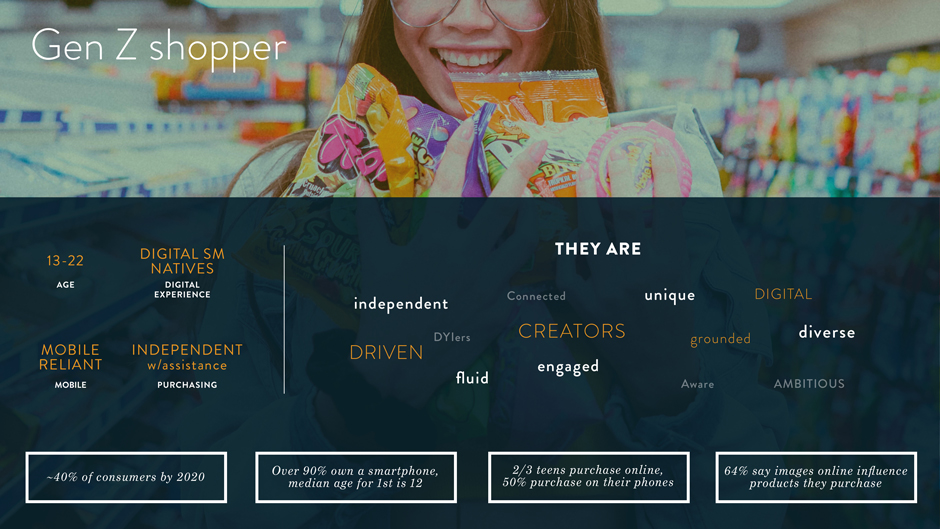
Members of Gen Z are 13–22 years old. 90% have their own phones, they make half their purchases using said phones and 64% say they’re heavily influenced by imagery online when making shopping decisions.[1] They don’t cozy up to brands. They ARE the brand. They’re not idealistic. They’re pragmatic. And they’re not curators. They’re creators.
Perhaps of most interest: Gen Z represents up to $143 billion in buying power, so understanding how they think, shop and consider the world around them is the next silver bullet.
Gen Z & Amazon: The Mall Effect
For Gen Z, going to Amazon to “hang out” is a thing. It’s a place where emotion trumps practicality, insightful content turns a sale, and the “mall effect” makes the Internet shopping giant the hottest place to see and be seen.
Like most shopping malls, Amazon is designed to facilitate the “Gruen Transfer,” or the moment when consumers enter a store and are intentionally surrounded by a confusing layout, which distracts them from their original intentions…priming them for impulse buys.
- They go to Amazon when they’re bored, just to hang out
- They scroll for days because of FOMO (Fear of Missing Out)
- They get hooked on color…imagining how everything would look with an outfit or in photos for social media (right down to their candy!)
Gen Z & Amazon: Brand Challenges and Solutions
Like every generation, Gen Z comes with its own set of challenges, many of them to do simply with the challenges of youth:
- Consistency of available funds
- Price Point
- Sorting through all the options on Amazon
- Waiting for delivery (vs. going in person)
- Reliant on parents account or funds
Gen Z Phenomenons & How Brands Can Meet Them Halfway
- Understand Ongoing Cart Curation—purchase may not be at the time of discovery. Gen Z are practical and their money isn’t always their own. They constantly browse, adding to their Amazon carts products they may need, products that catch their eye, or products they want to think about before making a final purchase. They are cash-strapped and are usually curating their Amazon cart while waiting for funds to become available. Making it into the Amazon cart is half the battle…making it into the final purchase is the win.[3]
- Craft an Experience—Gen Z are willing to browse until they find something that compliments or enhances who they are, and that helps promote their own brand.
- Show Them What You Can Do For Their Image—Gen Z have a desire to stand out and to be different, but they also need to be accepted and perceived as cool and unique. They’re searching for something no one else has or something they can “discover” that others will want to emulate. Creating unique experiences that help them visualize how your brand enhances their presentation as a person, will help break through the noise on Amazon.
- Prime It and Price It Right—Gen Z are more frugal than Millennials, so while they may be browsing and experiencing all their options, ultimately, they will filter down by Amazon Prime options and price. They are pragmatic and planners—and they want things fast. So while experiences matter…if they filter you out because of the lack of convenience or price is too high, you won’t even be considered.
- Build a Compelling Narrative—Gen Z view brands as representations of their values, an extension of themselves. If they associate with a brand, what does that say about them? Are they part of something bigger than themselves, something cool and unique? They don’t want you to talk at them, they want you to show them who you are and include them as part of the process. Consider your brand presence on Amazon and how you stand out against competitors in the same space. Authenticity, transparency and having a greater purpose are extremely high attributes valued by Gen Z.
- Break Through the Noise—Generation Z are digital natives. This is all they’ve known. They have incredibly short attention spans and are used to making decisions quickly. Add that to an incredibly noisy space of Amazon and their need to browse through everything, and you’ve got one chaotic blizzard of brands clawing over one another. Imagery, colors, showing people they can relate to, prime availability, and price all weigh heavily into your product being findable on Amazon and making it into the Gen Z consideration set.
- Cast a Wider Net—Millennials and GenX know what they want. They search exactly for that thing and get results served up that give us a selection of that thing, which makes a brand’s search strategy easy. If you’re selling sneakers, the search strategy would naturally include shoe-related keywords. But in a Gen Z world, where browsing is life and impulse buys online are the norm—they think about their purchases emotionally. So that same sneaker brand may need to start to look at keywords like “accessories.”
Reach Gen Z with eCommerce Agile Methodology.
Scrum50 is the first born agile marketing agency. Their mission is to marry world-class strategic creative with efficiency by embracing agile marketing approaches—employing shorter production sprints managed by uniquely-talented hybrid teams. They focus on three competency areas for clients: (1) Agency Services, (2) eBusiness, and (3) Digital Transformation.
[1] Generation Z, New insights into the mobile-first mindset of teens, think with Google, 2016 https://www.thinkwithgoogle.com/interactive-report/gen-z-a-look-inside-its-mobile-first-mindset/
[2] Generation Z, The Newest Generation, Response Media,
http://www.responsemedia.com/generation-z-the-newest-generation/
[3] Gen Z Amazon Consumer Journey Group Research, Scrum50, 2018
(more…)
Content Marketing is Dead
Leave a CommentContent Marketing as we knew it is dead. The days where you can pack your site full of text-based articles and watch your SEO results soar are gone. And so are the days of coasting by on the strength your brand name alone. Now, a new evolution of Content is more important than ever to your marketing strategy.
Non-branded searches are up 10% year over year.* That means your target audience is less likely to search for your brand – and more likely to search about topics they care about. The key for effective content creation is to find the intersection of what your customer cares about, and where your brand can provide expertise.
Today’s content marketing starts with defining your Authority to Publish. A brand’s Authority to Publish lies at the intersection of what their customer cares about and elements of a brand’s DNA. Here are a few questions you should ask as you improve content marketing efforts – both digital content and traditional content – for your brand.
4 Questions to Help Define Content for Your Brand
What content do my customers care about?
Sure, your customers care about a lot of stuff…so find out where our brand can connect with them. Start with search and SEO. Find out if anyone is actually searching for the topics you want to create content about. Follow trends. Ignoring news coverage and trending topics that relate to your brand could be very damaging.
Is my brand an expert or leader?
Define your brand’s area of expertise, then stick to it. There may be many, many, many topics your brand could use in an editorial calendar and content plan but narrow it down to your zone of expertise.
What content do customers realistically expect from my brand?
This is where that clearly defined zone of expertise really comes into play. Because if you’re a brand of house cleaners and you’re writing content about flower boxes…sorry, but you’re in the wrong sandbox. Customers don’t want to hear from your brand about things that are just barely in your circle of influence.
Where will anyone find this content?
Forgetting about content distribution is a common content strategy mistake. Your content plan needs to work hand-in-hand with your distribution channels. Each piece needs to have social media content supporting it – at the very minimum. And in most cases, paid social media, to get the pump primed.
Keeping Content Creation Effective
Keeping a close eye on your brand’s authority to publish is critical to creating effective content. There’s no sense in cranking out content for the sake of cranking out content. In today’s content marketing model, digital content needs to drive search, sales, awareness, and handle some reputation management – all at once. If you keep within a focused zone of expertise, your content will be much more effective.
* L2 Think Tank, Brand is Not Enough March 14, 2019
Mondelēz International Names Scrum50 its eCommerce Agency of Record
Leave a CommentSOUTH NORWALK, CT – Pioneer agile marketing agency Scrum50 has been awarded eCommerce Agency and Amazon Agency of Record (AOR) status for global consumer packaged goods company Mondelēz International, leader in biscuits, chocolate, gum, and candy, with brands such as OREO, Ritz, Chips Ahoy!, Belvita, Halls, Trident, Cadbury. The partnership solidifies Scrum50’s highly-regarded credentials in eCommerce, and specifically the Amazon marketplace, where many brands are struggling to keep pace with commerce platform and its many intricacies.
The AOR distinction was awarded after a series of successful 2018 projects together—including Amazon-specific Trident Vibes launch and seasonal Back-to-School/Halloween programs for Multi-Pack snacks, OREO, Sour Patch Kids, and Swedish Fish.
“In our relatively short time working together, Scrum50 has demonstrated a command of the Amazon landscape, delivered thoughtful, insight-driven creative, then executed efficiently through their agile approach,” said Chris Butler, Head of eCommerce NA at Mondelēz International “Our eCommerce channel has grown share in very competitive categories and seasons much quicker than anticipated thanks to Scrum50’s strategy and support.”
Setting Brands Up for Success in Amazon
In addition to their work for Mondelēz, Scrum50 has built successful eBusiness programs for Luxury Beauty and Fragrance, Gerber Naturals Baby Formula, Conair, Welch’s, Revlon, Elizabeth Arden and more.
“Our eCommerce success relies specifically on the category and shopper insights we develop together in partnership with our clients so that we can fully understand what makes them tick and then deliver that messaging and creative directly to them.” Says Stacy Thomson, VP of eBusiness for Scrum50, who leads the charge in client growth on the ebusiness side. “Our clients overall have found success through our work on their Amazon platform with our expertise and strategy from product details pages with custom content, to brand stores and display units.”
Press and Insights About the Scrum50 and Mondelēz International eCommerce Partnership
Originally published in: Marketing Dive
Naming Scrum50 as its designated e-commerce AOR points to how important e-commerce is becoming for Mondelez as well as for the consumer packaged goods sector more broadly. Mondelez said the agency was selected for its expertise in Amazon marketplace as evidenced in past efforts. Mondelez is clearly working to ramp up e-commerce across its brands as consumers, especially millennials, do more of their grocery shopping online. Amazon commands 30% of online grocery spending in the U.S., according to a Brick Meets Click survey cited by Supermarket News. P&G has also been pushing aggressively into e-commerce with new packaging, acquisitions and key partnerships and other marketers in this sector are similarly focused on establishing closer relationships with consumers through online sales.
Teaming up with Scrum50 will allow Mondelez to tap into a trove of product category and shopper insights that can help the company better understand its consumer base and deliver more personalized messaging. The news comes as Mondelez has already been bringing an e-commerce element to recent marketing campaigns.
Pickups also appeared in: AdAge and MediaPost.
What is eCommerce Agile Methodology? About CT Ad Agency Scrum50
Scrum50 is the first born agile marketing agency. Their mission is to marry world-class strategic creative with efficiency by embracing agile marketing approaches — employing shorter production sprints managed by uniquely-talented hybrid teams. They focus on three competency areas for clients: (1) Agency Services, (2) eBusiness, and (3) Digital Transformation.
Scrum50 named to Ad Age Best Place to Work List
Leave a CommentYes! Scrum50 is #14 on the Ad Age Best Places to Work list. We’re honored and proud. It means our culture of doing isn’t just productive, but it’s fulfilling for our employees too.
The Ad Age list is based on survey results from both employers and employees. It take all the usual stuff into account – compensation, perks, etc. – but also opportunities for advancement, diversity, responsiveness to issues…all those things that make people feel good about where they work.
We started from scratch – 2 guys and an idea for a marketing agency that just might be crazy enough to work. So we started the first born-Agile marketing agency back in 2014. Now we’re growing…and fast.
From our renovated factory space in South Norwalk, CT, we’re changing the way digital marketing agencies work. Our philosophy is faster better brilliance. It means we like to bring great ideas to life and test them in-market (instead of letting them fade due to over-discussion and over-crafting). Our teams are lean, and made up of multi-talented, multi-faceted polymaths who are encouraged to work beyond their titles.
Getting on this list proves that we haven’t just built a company, but a culture that lets our employees feel free to show off their unique talents, make an impact, and go to work in a great space with great people.
Want to come work with us? Let’s talk.
Scrum50 Takes Home the Gold at PRO Awards for Beech-Nut Campaign
Leave a CommentScrum50 was recently awarded a top honor from the 2018 PRO Awards for its 360-degree Beech-Nut Real Food for Babies Turn the Labels Around Campaign.
The win, a GOLD award for Best Cross-Channel Engagement, is the next in a run of accolades for the campaign—which included several TV Spots, an impactful Online Anthem Video, Social Media Activation, Digital Banners, Print Ads, Radio Placements and more.
“Turn the Labels Around” was built around proprietary market testing which revealed that what mothers feed their babies is just as much an emotional decision as it is functional. With nationwide “mom shaming” at the forefront in pop culture (from celebrities to social media), the combination of insight and timing was a winning one.
The campaign had a halo effect, boosting sales significantly and creating positive brand awareness and sentiment.
Scrum50 credits its unique Agile Methodology and an A-team of agency polymaths for its successes.
Cross-Channel Engagement
Winners are selected from 30 categories by a panel of senior-level brand and agency promotion marketing experts. Over 1,000 entries were submitted from around the globe; winning campaigns were named the best of the best due to their demonstration of clear strategic thinking and their success in reaching the target audience.
See the full list of the 2018 winners here.
6 Reasons Not to Ignore Amazon As a Content Platform
Leave a CommentThough Amazon is a behemoth on its own, at the end of the day it’s really no different than any other marketing effort when it comes to content strategy. Visuals must be thoughtfully designed. Copy needs to mean something. But what you might not be considering is that your search engine strategy and Amazon search strategy should complement one other.
You might be saying to yourself right now, “But no one goes to Amazon for CONTENT. They go to shop!” You, my friend, would be wrong. Amazon actually represents the #1 opportunity for content marketing at this present moment as 64% of Americans have Amazon Prime and 55% begin their product searches on Amazon. (And you know what they say about first impressions).
In this blog, I’ll show you six reasons why Amazon cannot be ignored as a content platform and how to begin your strategy today.
1. Brand Building Starts Here
Thanks to newly redesigned Brand Stores, brands can get excited about a unique, dynamic, and more visually-driven chance to meet consumers where they are. Think browsing magazine-worthy imagery, comparing features and pricing, and getting drawn in by the brand’s DNA. Plus, it not only helps you create another entry point for your brand by capturing consumers you might not otherwise reach, but it allows you to protect your brand reputation by controlling the quality of your marketing efforts. The flexible templates also provide a rich canvas to showcase content that completes the story around a brand and its products.And it’s already proving itself. Our clients have seen sale increases in less than 6 months thanks to these content-rich brand stores. Cha-ching!”

2. You Can Take Advantage of the Rabbit Hole
Similar to the “Target Effect,” there is certainly an “Amazon Effect.” You go in for one thing, you come out with a cartful of items you never knew you needed. Brands can maximize potential customer’s ‘browsing and buying’ mindsets by presenting them with relevant content at just the right moment. Sometimes that moment occurs when a customer is considering one of your competitors.

3. Easily Editable Format Lets You Tailor Content
Personalities and motivations to shop are different for all potential consumers. Amazon’s flexibility allows you to develop and design content that closely aligns with these unique need states (and to change them on the fly if needed). If you think about mapping the “Amazon Effect” against the classic marketing funnel, “search” typically falls within in the TOFU stage, and “reviews” within the MOFU/BOFU stage. The way people shop and browse is fluid. So, you’ll want to hit them wherever they are in the funnel at any given moment for maximum impact.

4. It Bumps You Up in Search (and Trust)
If you Google “toothbrush,” you’ll get a search engine results page brimming with listings. Among those will be manufacturer’s listings (brands promoting and selling their own products) and Amazon listings. Then perhaps more Amazon listings in several content-based forms (e.g. best sellers, top rated, most wished for, hot new releases).

Plus, you know that on Amazon you’ll have instant access to thousands of reviews, similar products that you can compare easily, and perhaps even have free 2-day shipping with Amazon Prime. Which listing would you click first? Likely the one that feels more like a neutral third party versus name brands hocking their own goods. Most consumers feel the same way. They inherently trust Amazon listings more. If that’s not convincing enough, even at the most basic level, having keyword-rich and interesting content on Amazon automatically gets you ranked higher in search engine algorithms. In other words, you can’t win if you don’t play. In fact, according to Consumer Affairs, 70% of consumers trust reviews from people they’ve never even met more than brand statements

5. You Can Kill Three Birds With One Stone to Drive Sales
Awareness, consideration, and authenticity—three key objectives for most brands that traditionally can only be accomplished in store—can be addressed in Amazon with the proper presence and content. Conversely, Amazon can help amplify in-store efforts against these same objectives by providing a way for consumers to scan packaging, get detailed information and reviews, or ask questions right at shelf with the platform’s mobile app.

6. Address Purchase Barriers and Consumer Feedback in Real Time
Consumers head to Amazon to really understand the nuts and bolts of a product, providing a rich opportunity for research gathering. Anything can inspire content: reviews, questions, problems, behaviors. It’s all fair game. And in using such inputs as impetus, you can solve issues and continue to build your brand, filling unexpected gaps in marketing efforts. That includes talking to consumers at a deeper level than even your brand’s website can go. This type of dual-functioning content can help not only online, but also has a halo effect on brick and mortar sales.

Amazon should be the bakery-fresh bread to your peanut butter and jelly. Aligning with your brand’s overall content strategy is key so that complementary Amazon content feels like part of the larger ecosystem. Everything needs to feel like it goes together. The bottom line? As a content platform, Amazon is a new package for some of the things you already do, and a testing ground to try something different when it makes sense…like a scoop of delicious marshmallow fluff, perhaps.
Have you implemented Amazon as a content strategy for your business? What results have you seen from these efforts? I’d love to hear about your experience in the comments. Let’s keep the discussion going.
Why Content Strategy is Key When It Comes to Corporate Responsibility
Leave a CommentMost big companies produce Corporate Social Responsibility Reports or Corporate Sustainability Reports (CSRs) detailing their efforts and future goals in corporate responsibility, to the tune of 85%. But only 17% of their intended audience are actually reading them.
And, that’s precisely what makes CSRs such a huge opportunity.
One study showed that when it’s done right, Corporate Responsibility can increase a company’s revenue by up to 20%. To get there, however, the traditional way CSRs are developed and presented must be turned on its head. Engaging key stakeholders in the Information Age involves making your data clear, concise and…well… engaging. Here’s why:
Stakeholders of all levels have equally short attention spans
There is a widely held notion that stakeholders aren’t like the general population and live for poring over long, complex tomes. Not true! (spoiler alert: they’re just like us). Making dense topics into scannable, digestible content isn’t just an art form. It’s a necessity. Everyone can reap the benefits of a beautifully animated chart, elegant video, or well-designed infographic over reams of text.

Readers want to understand your story
Storytelling is an important pillar of content strategy. Your CSR is a perfect place to lead stakeholders down a semi-linear path of discovery and hang onto them until the end. Why? So they get a clear picture of the values and aspirations of the company, and can feel good about attaching themselves to it. They need to be invested to invest. And a laundry list of your organization’s achievements just won’t cut it.

Delivering the right content at the right time is critical
Figure out the most universally impactful points and pull them forward, in thoughtful order, as “tapas” to be consumed and shared. Then, if your readers are still hungry, they can get all the details…or move on to the next course.
Here at Scrum50, our team of agile marketers are seasoned at taking complex, technical narratives and distilling it into experiences that readers engage with, learn from, and share. Check out our latest work with the NHL or Xerox for example. Like what you see? Contact us.
Scrum50 Founder Mike LeBeau Named to NY Festivals Advertising Awards Grand Jury
Leave a CommentScrum50 is thrilled to announce that Founder and Managing Partner, Mike LeBeau will judge the 2018 NY Festivals® Advertising Awards as part of the show’s prestigious Grand Jury.
New York Festivals International Advertising Awards® honors advertising excellence through 20 competitions in all media from 80+ countries and represents the full spectrum of today’s advertising communications: Activation/Engagement, Audio, Avant-Garde/Innovation, Branded Entertainment, Creative Marketing Effectiveness, Design, Digital, Direct & Collateral, Film & Film Craft, Integrated Media Campaign, Media, Mobile, Outdoor /Out of Home, Package & Product Design, Print, Public & Media Relations, Public Service Announcements, Sports and Student.
The NYF International Advertising Awards has the largest, most creative international jury and judging system in the world. The Grand Jury, conducted online, evaluates all entries to determine the Finalists. The Finalists are then judged by the Executive Jury, known as the “Dream Team” – an exclusive group of prominent worldwide Chief Creative Officers from the world’s top advertising agencies. This elite group comes together for five days of live judging to determine the 3rd, 2nd, and 1st Place Winners, the Grand Winners, as well as the one entry worthy of being named the Best of Show.
The 2018 New York Show℠ will be held at the renowned Jazz at Lincoln Center’s Frederick P. Rose Hall in New York City.
New York Festivals® celebrates the World’s Best Creative Communications. Our internationally renowned award-winning judges review submissions in the most current and relevant categories to award creativity across all media.
Scrum50 Wins MarCom Award For CLEAN Perfume Social Media
Leave a CommentScrum50 was recently awarded a top honor from The 2017 MarCom Awards for its work on CLEAN Perfume.
The win, an HONORABLE MENTION for Instagram, is the first for the 3-year-old agency who credits Agile Methodology and an A-team of agency polymaths for its out-of-the-gate success.
Judges are industry professionals who look for companies and individuals whose talent exceeds a high standard of excellence and whose work serves as a benchmark for the industry.
AMCP (Association of Marketing and Communication Professionals) is the industry’s preeminent third-party evaluator of creative work. The organization has judged over 200,000 entries since its formation in 1994.
See the full list of the 2017 winners here.
MarCom is one of the oldest, largest and most prestigious creative competitions in the world. MarCom is sponsored and judged by the AMCP, a 23-year-old international organization consisting of several thousand creative professionals. As part of its mission, AMCP fosters and supports the efforts of creative professionals who contribute their unique talents to public service and community organizations. Over the past few years, AMCP has given over $250,000 in charitable contributions.
Scrum50 Wins Top MarCom Awards For Beech-Nut Campaigns
Leave a CommentScrum50 was recently awarded 5 top honors from The 2017 MarCom Awards for its Beech-Nut Real Food for Babies Turn the Labels Around Campaign.
The wins, which include 1 PLATINUM award, 3 GOLD awards and 1 HONORABLE MENTION, are the first for the 3-year-old agency who credits Agile Methodology and an A-team of agency polymaths for its out-of-the-gate success.
Judges are industry professionals who look for companies and individuals whose talent exceeds a high standard of excellence and whose work serves as a benchmark for the industry.
AMCP (Association of Marketing and Communication Professionals) is the industry’s preeminent third-party evaluator of creative work. The organization has judged over 200,000 entries since its formation in 1994.
See the full list of the 2017 winners here.
MarCom is one of the oldest, largest and most prestigious creative competitions in the world. MarCom is sponsored and judged by the AMCP, a 23-year-old international organization consisting of several thousand creative professionals. As part of its mission, AMCP fosters and supports the efforts of creative professionals who contribute their unique talents to public service and community organizations. Over the past few years, AMCP has given over $250,000 in charitable contributions.
The Agency Sweet Spot: Why We Want to Keep Scrum50 Small
Leave a CommentBy Michael LeBeau, Chris Parker & Jennifer Miller
Here at Scrum50, we very purposely chose our name to coincide with our thought process about our agency’s goals and objectives. You probably picked up on the rugby huddle reference with our Agile culture, but why the 50 after it? We think that 50 is the sweet spot for our small agency. 50 employees, specifically. After three years in business, we’re 25 people strong, and on track to what we believe is a critical point in our agency’s growth. As founders, we’ve been through it all at previous companies –agencies with just a few people, agencies that grew into hundreds of people, and everywhere in between. We’re confident that 50 is the ideal number, and here’s why:
Personal Touch
We love personally knowing each and every one of our clients. We know who our customers are and we WANT to be involved in their business directly. The founders play a significant, active role in the agency and client business, which is important to our agency philosophy. We want to have that personal touch at every level, which we believe allows for our clients to get the very best service — the benefit of having senior level thinking for all accounts.
Strong Culture
When starting up Scrum50, we wanted our internal group of employees to feel like a team and have a true level of closeness. We wanted everyone to know each other — not just know of each other, but really build a close comradery that results in a thriving culture of happy employees. It also builds internal trust, allowing for quicker “short-hand” as the teams work through projects. Ultimately, we want our employees to thrive and provide the best work possible for our clients through a strong workplace environment.
High-Level Thinking
We believe that a small agency setting is the best place to grow new ideas and bring them to fruition. Because everyone in our agency organically knows what is going on with our different clients, we often find teams sharing ideas or suggestions being passed along. In brainstorming, we’ve also found that smaller teams deliver breakthrough thinking, while big groups, bogged down by too many cooks in the kitchen, tend to produce ideas that are more vanilla.
Superior Work
With small agency teams like ours, we have experts in every level and have brought together some great minds. Together, co-workers have a healthy competitive edge between each other, but not a destructive one. Everyone works towards common goals and has a collective role in our achievements. At this level, we get the best work out of the staff and they feel as though their work is being valued by the rest of the team.
Flexibility
An agency must be able to pivot easily when needed, an idea that goes along nicely with our Agile mindset. With a team of 50, shifting gears and changing our process is immediate, because we don’t have to go up the ladder at each level to make decisions. Keeping our team small provides the flexibility we need to keep our Agile systems in place and service our clients with whatever they need at the highest level.
Speed
Another key element to our Agile philosophy is speed — again, made possible with our small team. We want to work as fast as we can without those layers of hierarchy. We are nimble and faster and can get our great ideas to market quickly and efficiently.
Our size is an integral part of our vision, not the result of any circumstance. By keeping Scrum50 in the realm of a smallish agency, we provide the most superior end results and work for our clients, while also creating the best work environment for our staff. To use common big agency lingo, “It’s Win-Win.” And… we promise never to do that again.
Check out our feature in the Ad Age Small Agency Guide!
The Changing Face of the Agency Employee
Leave a Comment“Jack of all trades”
Most of us are familiar with this Elizabethan term that’s used equally to describe visionaries like Shakespeare and Leonardo da Vinci, as to discredit millennials with a frustrating lack of focus. In the modern agency world, however, the notion of being multidisciplinary has been granted new life as a prerequisite for employment (and success) in a digitally-minded landscape that is ever changing, ever more demanding and as a result, ever more challenging to keep up with. Those who can excel wearing lots of different hats (think: write copy, creative direct, sketch, take photos for social media, interface with clients and devise strategy all within a single day) have also earned a shiny, new name: Hybrids.
Speed Boats vs. Cruise Ships
Agencies have come a long way since their “Mad Men” days. Bill Bernbach’s Creative Revolution of the 1960’s brought about the partnership of copywriters and art directors, while the digital age added developers and coders to the mix. However, the silo-mentality that segregated disciplines in those agencies of old, is refusing to go quietly—and in some cases is so entrenched in the DNA and culture of creative shops that it has stymied their evolution and growth. The lines between marketing mediums (media, digital, social) have blurred, and so have the boundaries of traditional job descriptions to support them. Today’s consumer-driven world calls for a consumer-centric marketing approach. In fact, it’s the only strategy suitable for the speeding current of the rapid, fluid digital world in which consumers, not brands, have all the control. And that leaves much of the old, hulky traditionally segmented way of doing things bobbing sadly in its wake.
What’s Next: Agile Revolution & The Polymath Reincarnation
We are once again on the cusp of a new age of advertising and marketing. Smaller tests beat big bets, ongoing engagement is a way of life and Content is King. In order to be flexible and fast-acting (after all, who wants to be left behind commenting on the latest Game of Thrones plot twist?), the same flexibility must be required of its creators. Brands need agile agencies, and agile agencies need hybrids—also called polymaths, renaissance men or unicorns…OK, we’ll also answer to ninjas. People who are passionate about the work they do and are comfortable being uncomfortable. In other words, those who might spend their days playing any number of old-world roles: account director, producer, art director, UX designer, analytics specialist or strategist depending on the needs of the client challenge or what the moment dictates. And killing it every time.
Always Learning
Quora Design Director, David Cole wrote that “Learning is not a zero-sum activity.” That goes for everyone—agencies and employees. For too long, hunches have trumped real insights. And limiting talent with a too specific job-description trampled multipotentialities. But, no more. And that’s why we’ve been doing it differently all along.
Culture of Doing
When we conceived Scrum50, we planned on doing more with less. Less people, less time, less money. Better vision, better creative, better end results. We believe that agencies can work smarter and get even better results through agile marketing tenants where tight knit teams are working together empowered to take action and get results. When building the right staff to fulfill our vision of world-class creative, we looked long and hard to find nimble people with ambition and a “get it done, and get it done great” mentality. Most importantly, we wanted to put our multi-talented employees to the best use possible. So, what to do with a Project Manager that has an eye for creative? Or a Media Buyer who has a knack for writing social? You harness that shit.

These are talented individuals that not only have strengths in multiple areas, but do better when engaging in ALL of their skills. Ditching the siloed, single-focus mindset of the outdated agency structure, Scrum50’s polymath employees are able to develop their full potential by utilizing all of their strengths and skills. It works out for everyone. Employees are motivated and happy when they are challenged and do things that they love. And that translates into long-term employee loyalty as well as the best end result for our clients.
As modern Da Vincis, these standouts are shaking up the advertising landscape just like the renaissance men of old who combined their prowess for science, philosophy, theology and the arts to make amazing progress in the world.
Making Agile Work For You
So, how did we get here? We planned for it from the beginning. But you can start by retooling the way employees and roles are structured. Think about how you can get the most and best work for your clients out of the experts you already work with every day and mine for that talent. Then, make multipotentiality criteria moving forward as you add new people to your roster.
After 3 years, we haven’t looked back…not even once.
We’ve built an agency squad that’s more like a badass SWAT team. Polymaths picked at their peak for departments, like our Agile Content Studio which produces on-the-fly social posts. We’ve got editors who write, produce, and project manage—PrEditors for short. We’ve found gems right in our own backyard—like the incredible Dom, our Art Director who is multimedia-video-driven and an expert retoucher; or Erin, our Content Manager who is a social-writing, media-buying, insight-researching, analytics reporting powerhouse. To Dana, our Associate Content Director that writes as well as she strategizes, and Brad our UX and design guru and resident go-to guy.
We believe we’re set up for success, but our eyes are on the horizon. Keeping the momentum going and continuing to ride the wave of innovation is the ultimate goal. And we’ll do it until the winds of consumer behavior shift and the ever-changing marketing landscape send our multi-talented team of polymaths chasing the next adventure.
5 Principles for a Mobile-First Mindset
Leave a CommentWhen it comes to digital design, there are multiple factors to consider when you first attack a project. Visually, where do you start? Beauty vs. functionality? Desktop vs. Mobile? Which gets priority? Where to begin? Let’s be clear – your digital experience needs to work flawlessly across all major devices to create a cohesive design and seamless communication so that your audience can choose where and how they want to engage with your brand.
In general, we as humans spend the majority of our time digitally on mobile devices rather than actual computers (71% of our digital time to be exact). Since more people are looking at your website on their phones as opposed to their computers or tablets, we have our answer! The mobile-first mindset is again reinforced by attacking the most difficult design challenge first – the limited space constraints of the mobile screen. As designers, we need to figure out how to capture the attention of the audience and portray the brand effectively in just a few inches. Not an easy task, my friends.
So to help deliver a flawless experience for your customers, here are a few UX principles to keep in mind as you start designing:
Create a Fully Responsive Experience
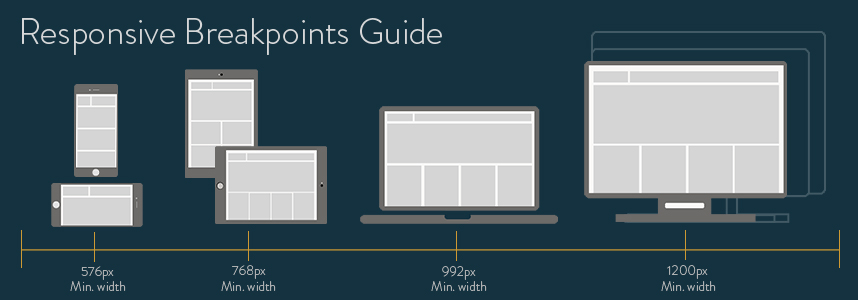
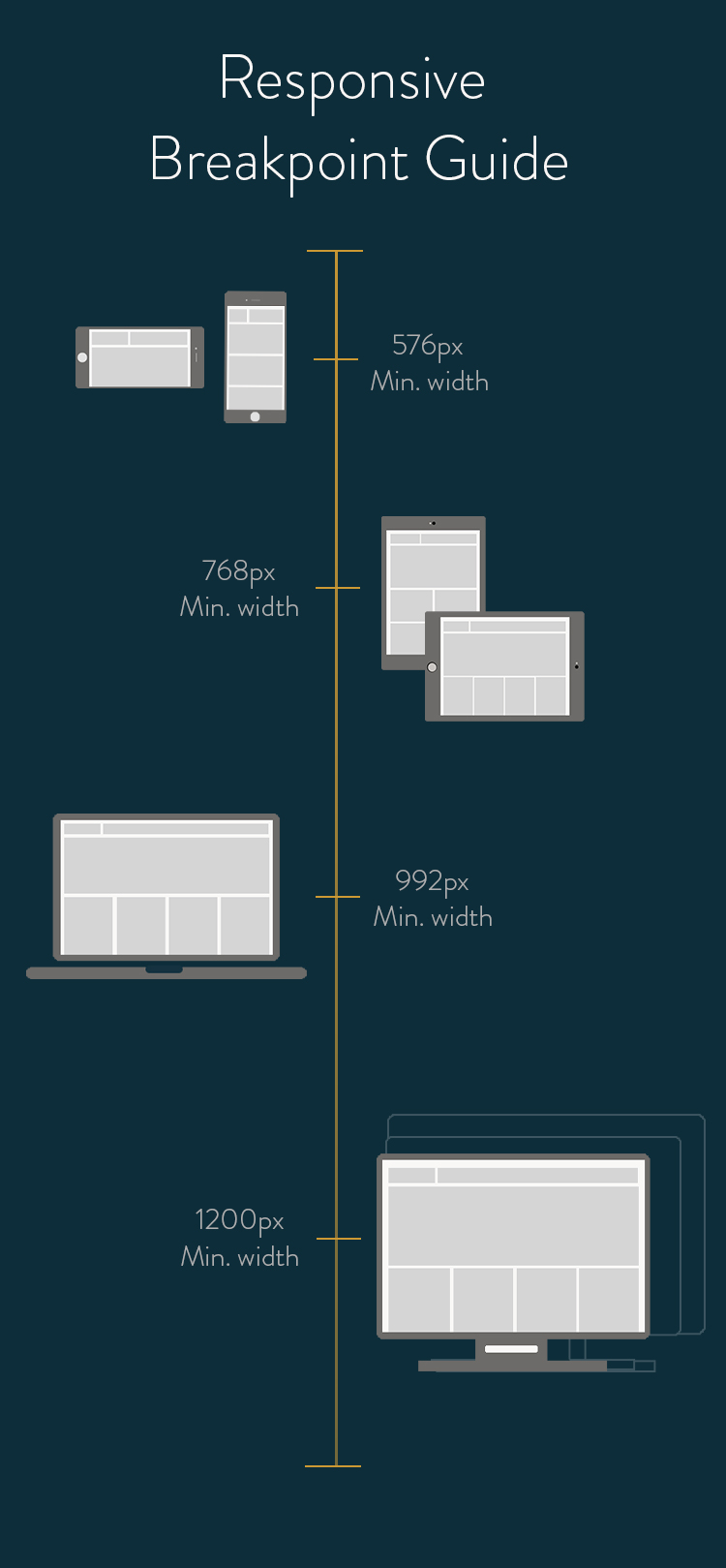
Being fully responsive means that whatever device your customer is using, the experience shifts and modifies to optimize for each device. The industry is moving to a place where the optimal design is dictating the breakpoints. You may start with a certain breakpoint but designing the interface to look good and be functional is the primary goal, therefore your breakpoint may shift to accommodate the best design solution. The jury is out, by the way, on how large is the largest size you should accommodate. 4K resolutions are not super common for the mainstream, but they are gaining traction. You really just need to know your audience to determine the outer-limits resolution to plan for. Here’s a guide to the most common starting points.
Don’t Reinvent the Wheel
Users are familiar with the main mobile operating systems and are already familiar with how they engage with websites on their mobile devices. Generally speaking, there is no need to completely reinvent what they are already familiar with. Take a que from common operating systems. For example, iOS and Android have already set up a strong visual vocabulary for button styles, toggles/switches and actions (swipe, pinch, tap, pressure-based actions, etc). You’ll want to mirror common user experiences, but use your brand identity to customize the experience.
Keep Content Visual
Content is King, and engaging, storytelling visuals are what rules today’s digital world. As our attention spans fade and consumption of mobile content increases, people’s expectation of visual content increases. They want to see more images, more videos, more infographics and more compelling (but also short) copy that gets right to the point and supports the visuals. As you are writing for digital, keep it crisp and cut out the excess clutter. Consider meshing amazing visuals and succinct copy for a win-win. (And yes, SEO is always important, but there are other ways to optimize for keywords other than copy-heavy pages.)
Functionality is Critical
The days of truncating the experience for mobile are over. Users expect to be able to perform the same interactions on their mobile phone as they can on any computer. They want what they want, when and where they want it. So, how do you translate a large screen into a tiny hand-held device? From a design perspective, that may mean abridging the UI elements themselves – for example using icons on mobile where words are used on a desktop.
Size Matters
When designing for a smaller mobile device, it goes without saying. It’s also important to consider your audience and keep the UX at the very forefront of your design elements. Font sizes need to be large enough for them to read, but small enough to fit on the screen. Touch targets like buttons need to be usable for your audience. Make sure you are allowing enough size on the screen for male targeted sites vs female targeted sites. Minimum size is generally 48px x 48px, erring on the larger side to avoid the dreaded “fat finger.” Images need to load quickly and create a consistent feel with the other elements on the screen. No matter how you dice it, size is critical in designing for mobile.
Keep these principles top of mind as you set out to design digital experiences that can be viewed on any device. A simple, intuitive user experience is what makes the biggest brand impression on your customers and these concepts outlined above set the foundation for success.
10 Reasons Why Agile Marketing Is A No Brainer
Leave a CommentWhat is Agile Marketing? Agile originated with software developers and tech companies like Apple, around the time that manufacturing companies pioneered “lean manufacturing.” The lean mentality started at companies, like Toyota, as a way to speed up production, promote collaboration, and identify cost efficiencies. And it’s a process that can be applied in a number of industries, more specifically, marketing and advertising.
Today, many brands and agencies still do things the old, traditional way (long lead times, high costs, modest success). That’s where Agile comes in…as a catalyst for the relentless pursuit of iterating and scaling to bigger, better ideas with efficiency and speed. A model much better suited to keep pace with the entrepreneurial spirit (and budget sizes) of companies today.
Here are ten reasons why companies of all sizes should embrace Agile Marketing:
1. Ongoing Engagement vs. Risky Big-Bang
Dumping all your money into a giant bet (unless it’s for a truly strategic reason) might take your brand to the cleaners…instead of to the bank.
The Agile Marketing approach calls for quick validation of ideas. Before launching full-scale campaigns, Agile allows you to learn early if the concept resonates. First, decide on an MVP (Minimal Viable Product)—this is the simplest essence of your final output. Then, get it in front of your audience. Your MVP might be a social post or an email, but its purpose is to gather immediate learnings. Ideally, test several versions in order to fail fast on the ones that don’t work and scale the ones that do. This process takes the opinion and subjectivity out of the equation, because crossing your fingers and hoping a concept will work for the market does not protect your investment, or guarantee success.
2. Scale What Works. Kill What Doesn’t
The beauty of real-time means you can dial up success and knock out failures fast.
One of the tenets of Agile Marketing is to start small, learn and scale. Once you understand what a customer responds and relates to, how you improve your output is critical. The Agile process allows teams to apply their learnings to a better and smarter version of their MVP—that’s when the real iteration begins. This fundamental approach allows you to keep up with and stay ahead of the rapidly changing marketplace.
3. Transparency, Collaboration and Trust
Daily rundowns make “agencies” and “clients” more like friends.
The Agile Marketing process inherently builds stronger teamwork between internal and external teams. Deep hierarchies have no place in Agile. Upper management must either be an active participant in the process, or empower someone on your team to make decisions on their behalf. It’s about making decisions quickly and not about watering down the ideas through internal gatekeepers. Success depends on the ability to get raw (but polished) ideas out to consumers quickly. Daily stand-up meetings keep the momentum going and foster an environment of self-regulation and responsibility. Key team members gather every day for 15 minutes to discuss 3 things: what did you get accomplished yesterday, what will you accomplish today and what barriers are in your way to accomplishing those tasks? This constant contact and collaboration creates true “community” within the workplace. Agile Marketing requires trust, face-to-face discussions, decisiveness and a general feeling of ownership across the teams.
4. Creates a “Culture of Doing”
We could spin in meetings all day long, but we all know that’s not how work gets done.
While you hope that all employees have the same spirit and personal stake in the work that you do, Agile Marketing encourages a sense of urgency among all employees to “get it done.” If the right people are empowered, there are less meetings, less wasted time and less roadblocks.
5. More Focus = Better Quality
Prioritized sprints without the churn and burn, make the work sparkle and the brand shine.
With daily stand-ups and project management tools (i.e. Trello, Slack, Jira, among others) designed to itemize tasks, assign owners and aid in real-time communication, all internal and external partners know:
- Exactly what’s going on at all times during the project lifecycle
- Who is responsible for what
- How (client’s) money is being spent
An equally important piece to the workflow is splitting the work into two-week sprints.
Assigning a deliverable at the end of every single sprint cycle also ensures that the team feels confident it is getting value out of the process.
6. You can do more with less
We’re all expected to drive more growth with fewer dollars. Now, we can.
Brands have limited resources and Agile allows teams to focus on what’s important and impactful, letting busywork fall by the wayside. By breaking down all projects (large and small) into manageable deliverables, and creating a backlog of all tasks to be done, the team can work together to promote the most pressing or easily doable tasks into the sprints.
7. Test. Optimize. Iterate.
Let consumers decide what they like, then take those insights and build on them.
Brands can’t afford to be slow to market, nor is there budget to outspend the competition. But you can outsmart and outpace bigger, more cumbersome agencies and brands with Agile Marketing. It allows (more like demands) teams to stay on top of trends, and learn what customers think in real time so they can turn around and utilize those data-driven results.
8. Meet consumers where they are with tailored conversations.
You need to approach your target and break the ice with common interests.
The days of crowded lecture halls are long over. Consumers expect to be courted, and your opening line better be good.
9.0 It makes your brand interesting.
Small talk doesn’t cut it. You need to mine for content diamonds.
Brands often struggle to find a place in the constantly changing digital world. Successful brands make killer content, and killer content is created by digging deep for reader insights and unearthing smart, sometimes obscure, nuggets of subject matter.
10. Flexible and fast-acting.
Something huge happen? Jump on it immediately and create relevancy before you can say, “John Snow Lives!”
You’re either on time, or you’re late. Being agile allows you to move quickly with less red tape so your message can see the light of day before the night is over.
Agile Marketing gets your teams to faster, better, brilliance in half the time (or less!) than traditional approaches allow, so you can get to market and in front of consumers quickly. Because the reality is, having the right message at the right time (before your competition) is critical to standing out from the crowd and winning consumers hearts—and wallets.
Our Top 5 Social Media Rules in Today’s Agile World
Leave a CommentIt’s no secret that here at Scrum50, we’ve built our business on the changing dynamic of today’s fast-paced world. Thanks to the plethora of technology that makes it possible to speed up the exchange of information, we’ve got it all at our fingertips at any given time. Social media channels play a HUGE part in this shift in mindset. The immediate sharing of content, and the instantaneous engagement of brands with their audiences, make social platforms fertile ground for testing out new ideas and gathering real consumer feedback.
We pride ourselves on helping clients like Beech-Nut, Fusion Brands and Spark Modern Fires build a deeper connection with their consumers through their social media channels. Through it all, we’ve come to develop a set of universal best practices when it comes to customer engagement on social. We wanted to spread the love and share our top 5 social media rules that we live and breathe by on a daily basis.
1. Have Your Process Down Pat
Moving at the speed of light means lots of planning ahead. It all starts with a brand narrative. What story do we want to tell at a higher level? What does the editorial posting calendar look like? Who is responsible for what aspects – from imagery, content, feedback, monitoring, etc.? Taking the time up front to plan as a team so we’re all on the same page moving forward is ESSENTIAL to social media success. Having your plan and process in place from the start allows you to take on anything and everything that comes your way. For us at Scrum50, this allows our team to be nimble to tackle the unexpected.
2. Agile Doesn’t Mean Be Reactive
Social media can be a very reactive channel. As everyone knows from public figures on Twitter (or Snapchat or any other network), whatever you put out on social is there for good. Even if you delete it 30 seconds later, you can be sure that the post isn’t going to just die. Good or bad it will take on a life of its own. At Scrum50 we make it a point not to be reactive. Even though we are Agile (note: Agile doesn’t mean purely speed), we still make sure to take a breather and fully think through any potentially controversial posts to understand the different reactions that may occur. Sometimes you want that controversy to create a stir and other times you don’t…just make sure you think it through because that post is living on whether you want it to or not.
3. Sometimes Less is More
In this sense, we mean specifically the number of different channels. Many times we see companies that want to have a presence on each and every social media network out there. Facebook, Twitter, LinkedIn, Pinterest, YouTube, Instagram, Snapchat…the list is endless. But, if you are leaving these channels empty and not engaging thoroughly enough or the right way for that channel, it’s not a good look for your brand. We believe that it’s a much more efficient use of your time and budget to create great content for one channel vs. mediocre content for several. It’s best to focus on the channels that make sense for your brand, are popular with your target consumers and that you have time for. Add on when and if you are ready, but keep it simple to highlight your brand most effectively.
4. Make Smart Changes
Social media is inherently Agile. Pretty much right away you can see what’s working and measure the images getting the most likes, messages with the most comments and overall understand what concepts are most engaging to your audience. The more you know, the better you can be. So, set aside time to look at results and compare the best posts getting traction, creating conversations, and driving website traffic. Then you know what’s working and can only to continue to improve from there.
5. Engage, engage, engage
We consider social media an ongoing conversation between the brand and their core audience. The best advice that we can give for social media is to create great content and keep it going. Continue the engagement and create a dynamic conversation that you actually want to be a part of. These are the types of conversations that build trust and keep your customers interested and engaged in what your brand has to say, because they actually like you and enjoy the conversation.
So, there you have it. Plan ahead, learn, build, create great content and your social media channels will continue to grow.
Scrum50 Reimagines Content Creation with New Agile Lab
Leave a CommentHere at Scrum50, we’ve been creating content since our inception in 2014 for clients like American Express, Xerox, Nestlé Waters, Conduent, Beech-Nut and more. Our clients love our strategic approach and methodology to create effective content to promote their brand message. We’re excited today to formally introduce you all to our Agile Content Lab. We’ve formalized our process, fortified our structure, and even hired a snazzy new content lead to strengthen our strategic approach.
Now we know what you’re saying… ‘sure, every agency has a content studio of some kind’. But not like this one. Our agile approach to content creation is what makes us different. We start with lots of little germs of content and messaging ideas, push them to market at lightening speed and with our proprietary algorithm, gauge which content and message gets the most traction with consumers. Then, we quickly grow those messages to bigger, better and more brilliant content, ideas and campaigns. We place smaller, less risky bets out there in an effort to scale the sure things.
Part of our process includes our Narrative Architecture approach that we employ for our clients that essentially defines their authority within their space in an engaging way. Think of it this way…we’ve all been to cocktail parties where there’s that guy who only talks about himself and how great he is without actually engaging in conversation with others. Let’s call him Bob. Well, Bob becomes boring really fast. He stands and holds court amongst unsuspecting party-goers who just came to have fun and meet some interesting people. Don’t be like Bob. We help your brand find the common interest with your customers and build a narrative approach to keep those customers interested in you because they like you, not because they’re held captive.
As part of the Scrum50 creative department led by Executive Creative Director and Partner, Jen Miller, Brady Coffey, VP Content Director, was brought on to run the Agile Content Lab overseeing a fulltime and contract editorial team along with video capabilities and executive producer. Coffey joins Scrum50 from past agency tenures at Digitas, Epsilon and Ryan Partnership, where he created work for the NFL, NASCAR, Abercrombie, MasterCard, Dove, Dove Men+Care, Hellmann’s and Simple. While he may not know a hooker from a line-out, he did rock a rugby shirt with wide-wale cords back in college. It was the ’90s. You know, back around the same time the Internet was being invented. So that means he’s been there since the beginning. Back when content was nothing more than HTML text littered with blue, underlined hyperlinks. We’ve come a long way since then, as have Brady’s fashion choices.
Nowadays we expect content that is more engaging, contextually relevant and intrinsically valuable. That’s the type of stuff we spend our time on, and that’s exactly the type of work Brady is leading at Scrum50. With his deep understanding of what motivates people to connect with brands, Brady is poised and ready to unleash Scrum50’s agile marketing ninja skills on an unsuspecting, content-hungry public.
Working Smarter Is Better Than Working Harder
Leave a CommentBy Michael LeBeau
CEO, Managing Partner, Founder
Scrum50
My favorite quote is from the “Wizard of Westwood,” John Wooden, the UCLA head coach who won 10 NCAA national basketball championships in a 12-year period, including seven in a row:
“Never mistake activity for achievement.”
— John Wooden
Everybody loves to learn from winners, and there was nobody better than Wooden in his business. His teams won a men’s college basketball record 88 consecutive games. Wooden’s unbelievable streak of seven consecutive NCAA championships needs to be considered in context: to this day no other coach or school has won the tournament more than two consecutive years.
Wooden’s wisdom teaches that:
- Working smarter produces more than working harder.
- Focusing on getting things done is what counts — not how busy you are.
- Dedication is what enables you to overcome obstacles and think creatively in achieving your goal.
- Streamlining your workload is vital, because if what you’re doing doesn’t lead to your goal, you shouldn’t be doing it.
The Design Sprint, the Google Way
Leave a CommentBy Michael LeBeau
CEO, Managing Partner, Founder
Scrum50
People pay attention when they hear Google is applying agile marketing to its creative processes. Google’s process is a six-step methodology called, “The Design Sprint.” It’s a way for designers to attack a marketing project and gather comments and quickly integrate that input.
Google “Google Design Sprint” and you will see at the top of the Google results in an article titled “How To Conduct Your Own Google Ventures Design Sprint.” There are a number of articles in the results below that article.
I like to point out that agile methodology is spreading beyond the marketing industry, but the impact is large, deep, and, may I say, “tectonic” in the marketing field because big brands are hustling to embrace it.
As Google pointed out, agile marketing’s technique of the “sprint” gives marketing teams a shortcut to learning without building and launching.
The interesting thing is the resistance level that agile methodologies are continuing to encounter at terminally traditional advertising agencies and old-school companies since this “lean mentality” was introduced.
Sooner or later, even the dinosaurs among us will need to embrace the agile movement…it’s the way the world is heading.
How Does Market Research Help You Succeed?
Leave a CommentBy Michael LeBeau
CEO, Managing Partner, Founder
Scrum50
Agile Marketing eliminates the need for traditional market research because there is an inherent feedback mechanism woven into the fabric of the movement Here’s why:
- “Agile Marketing has no room for subjective opinions (which are often wrong) and instead rely on objective consumer feedback (which is often accurate).”
- “The most accurate market research is when we can observe behavior (what people really do) rather than ask a bunch of questions.”
- “As agile marketing takes hold, market research will take the form of quickly deploying ideas into the marketplace and making decisions based on the behavioral feedback we gain. Scale up what works, dump what doesn’t.”
- We don’t vet ideas through the “dream crushers” at an agency or client who turn everything to vanilla. We incubate hypotheses which we then grow and field test. We let customer behavior be the final arbiter in our market research.
- By quickly getting an idea into the hands of consumers, you’re relying on the marketplace to verify your concept. You improve this “research” with each iteration. It’s like placing a lot of small bets rather than one big high-risk one.
- Agile is inherently quicker not just because the team is smaller and more nimble, but because you’re not waiting months to gather input.
- Rather than the traditional campaign development cycle in which you’re briefed by a client, go through a lengthy planning process, formulate ideas, mull them over, and finally present a concept, agile identifies a selection of smart ideas and quickly puts those concepts out into the marketplace to validate which ones actually work.